

Stay with us and find out where the next one takes us.
- Vinyl vs CD vs Lossless Streaming – Which Format Preserves the Most Detail in Music? - October 16, 2026
- Everyone Seems to Be Moving to Texas – What Is Drawing So Many People There? - October 16, 2026
- YouTube Is Finally Making AI-Generated Music Easier to Spot, but Can We Trust the Labels? - October 15, 2026
Matthew McConaughey left California and settled in Austin. Joe Rogan moved his family and podcast operation there in 2020.
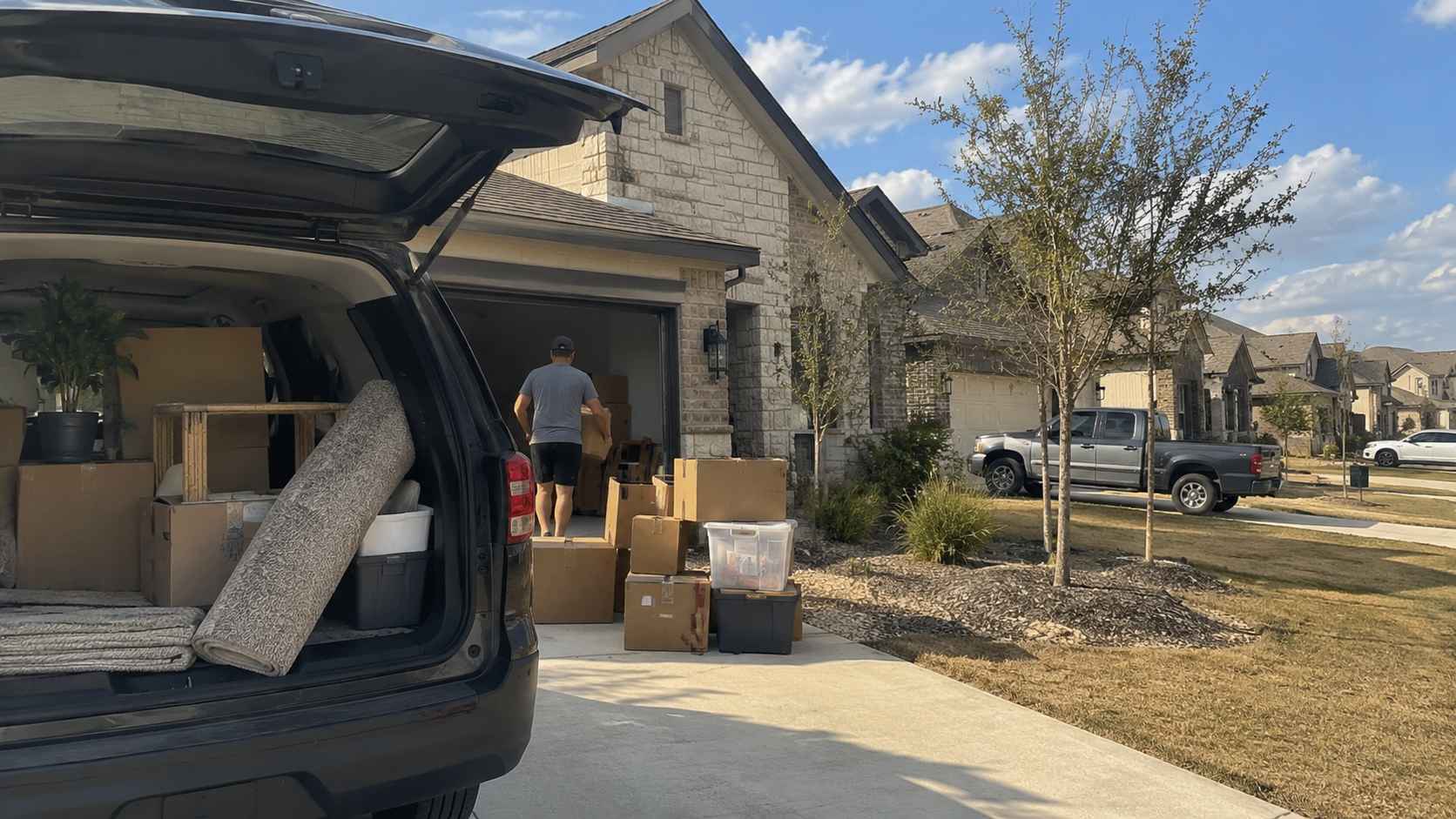
Meanwhile, thousands of ordinary Americans have been making similar decisions, exchanging expensive housing markets for Texas cities where their money can still buy a comfortable home.
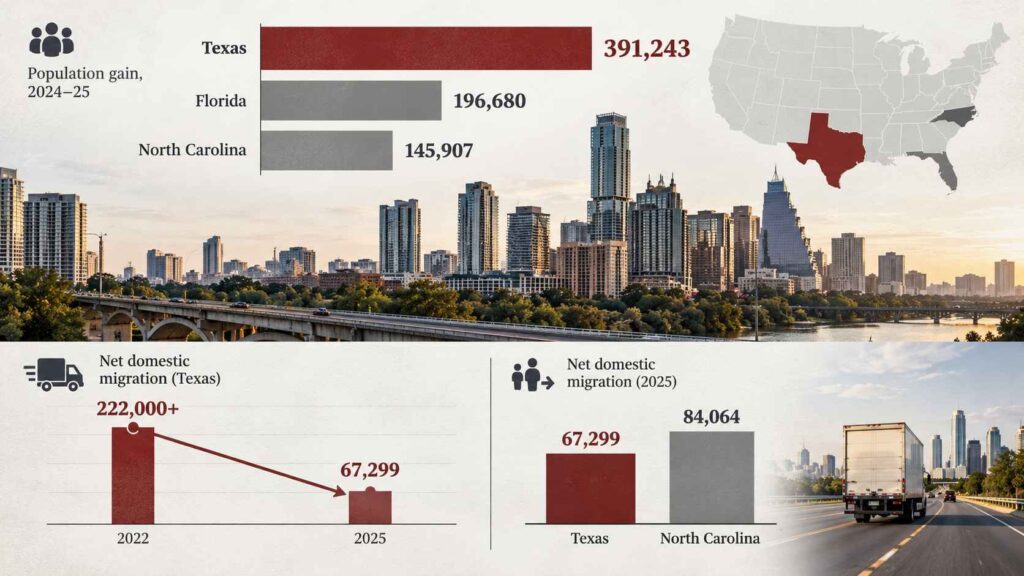
Texas added 391,243 residents between July 2024 and July 2025, more than any other state. Its population reached 31.7 million, and the state continues to attract workers, families, entrepreneurs, and retirees.
Affordable housing is a major reason, although prices have risen considerably in some neighborhoods.
Texas Is Still Growing, But The Migration Boom Has Slowed
The latest U.S. Census Bureau population estimates show that Texas gained 391,243 residents between July 2024 and July 2025. Its population increased from 31.3 million to 31.7 million.
Texas recorded the largest numerical population increase in the country, ahead of Florida, which added 196,680 residents, and North Carolina, which gained 145,907.
However, Texas no longer leads the country in net migration from other states.
According to the Texas Tribune’s examination of Census data, the state gained 67,299 residents through net domestic migration during the year ending in 2025. North Carolina recorded a larger gain of 84,064.
Back in 2022, Texas gained more than 222,000 residents through net domestic migration. The substantial decline since then suggests that fewer households are willing or able to relocate than during the earlier boom.
High mortgage rates, moving expenses, and uncertainty about employment can all influence relocation decisions. Someone who secured a low mortgage rate several years ago may hesitate to sell their current home and take on a more expensive loan.
Texas nevertheless remains attractive to people arriving from expensive metropolitan areas, particularly those who can keep their existing income after relocating.
Jobs Are A Major Reason People Keep Choosing Texas
Texas has more than oil companies and cattle ranches. Its largest metropolitan areas have substantial employment opportunities in technology, healthcare, manufacturing, finance, logistics, and professional services.
The Texas Workforce Commission reported 14,468,000 nonfarm jobs in July 2026. The state had added 165,600 jobs over the previous twelve months, an annual increase of 1.2%.
Private education and healthcare services recorded the largest monthly employment gain in July, adding 5,900 positions. Professional and business services also contributed to employment growth.
Large employers attract workers directly, but they also create opportunities for smaller businesses. New offices and industrial facilities need construction workers, maintenance companies, accountants, restaurants, and transportation services.
Austin Has Technology And Creative Industries
Austin has attracted companies involved in software, semiconductor manufacturing, and technology services. Apple has a major presence in the region, and Tesla operates its large vehicle manufacturing facility near the city.
The University of Texas at Austin also contributes to the local economy through research and education.
Technology jobs are appealing to workers seeking salaries associated with major coastal markets. However, employment competition can be intense, and the cost of living in popular Austin neighborhoods has increased considerably.
Dallas And Houston Offer More Than One Career Path
Dallas has a large corporate sector, with employment opportunities in finance, telecommunications, transportation, and technology.
Houston remains closely associated with the energy industry, but its economy also includes major healthcare institutions, engineering firms, logistics businesses, and aerospace activities.
Someone moving to Texas for work should compare actual salary offers rather than assuming every job will pay more. A lower cost of housing is less useful if the move also means accepting a substantial pay cut.
Texas Has No Personal State Income Tax
One reason Texas attracts high earners is that residents do not pay a personal state income tax.
For someone moving from California, New York, or another state with substantial income taxes, the potential savings can be significant.
A worker earning $150,000 annually may keep more of that income after moving to Texas, depending on the tax rules in the state they previously lived in and their personal circumstances.
Federal income taxes still apply, of course.
Property Taxes Can Reduce The Savings
Texas relies heavily on local property taxes to fund schools and other public services.
Unlike personal state income tax, property tax bills vary by location and the assessed value of the home.
According to the Texas Comptroller’s property tax guidance, local taxing authorities determine rates and collect property taxes.
Someone buying a large house in a developing suburb should examine the actual tax bill before making an offer. Certain properties may also fall within special taxing districts that add to the annual cost.
A household moving from California could save money on income taxes but still face considerable property taxes, homeowners insurance, and summer electricity bills.
Which Celebrities Have Made Texas Their Home?

Texas has produced generations of musicians, actors, and entertainers. Several famous personalities have also moved there after establishing careers elsewhere.
Matthew McConaughey Lives In Austin
Matthew McConaughey grew up in Texas and later built a successful acting career in Hollywood. He eventually returned to Austin with his family. In a 2024 interview reported by People, McConaughey discussed why living in Texas felt connected to his idea of home.
He and his wife, Camila Alves McConaughey, have spoken publicly about leaving California and choosing Austin as the place to raise their children. The Academy Award-winning actor also has close connections to the University of Texas at Austin and remains a recognizable presence in the city.
Joe Rogan Moved His Podcast To Austin
Joe Rogan relocated from California to Texas in 2020, bringing his popular podcast with him. Austin became the home of his podcast production, helping attract comedians, podcast guests, and other entertainment figures to the city.
His decision became one of the most widely discussed celebrity moves during the period when Texas was attracting particularly large numbers of newcomers.
George Strait Remains Connected To His Texas Roots
Country music legend George Strait has spent much of his life in Texas and has maintained property interests in the state. Although he sold his former San Antonio mansion in 2021, his connection to Texas has continued through ranching and other personal interests.
As Architectural Digest reported in 2026, Strait has a ranch near Laredo and continues to enjoy activities associated with rural Texas life. His music also helped shape the national image of Texas country culture, particularly through songs such as “Amarillo by Morning” and “All My Ex’s Live in Texas.”
Willie Nelson And The Texas Music Tradition
Willie Nelson is another musician whose name is inseparable from Texas. Born in Abbott, he became a central figure in outlaw country music and helped establish Austin as an important destination for musicians during the 1970s.
Nelson has maintained long-standing connections to the Austin area and his Texas ranch, although his professional life also takes him to other parts of the country. His influence is particularly visible in Austin, where country music shares stages and audiences with blues, rock, folk, and independent artists.
Austin, Dallas, Houston, And San Antonio Offer Very Different Lifestyles
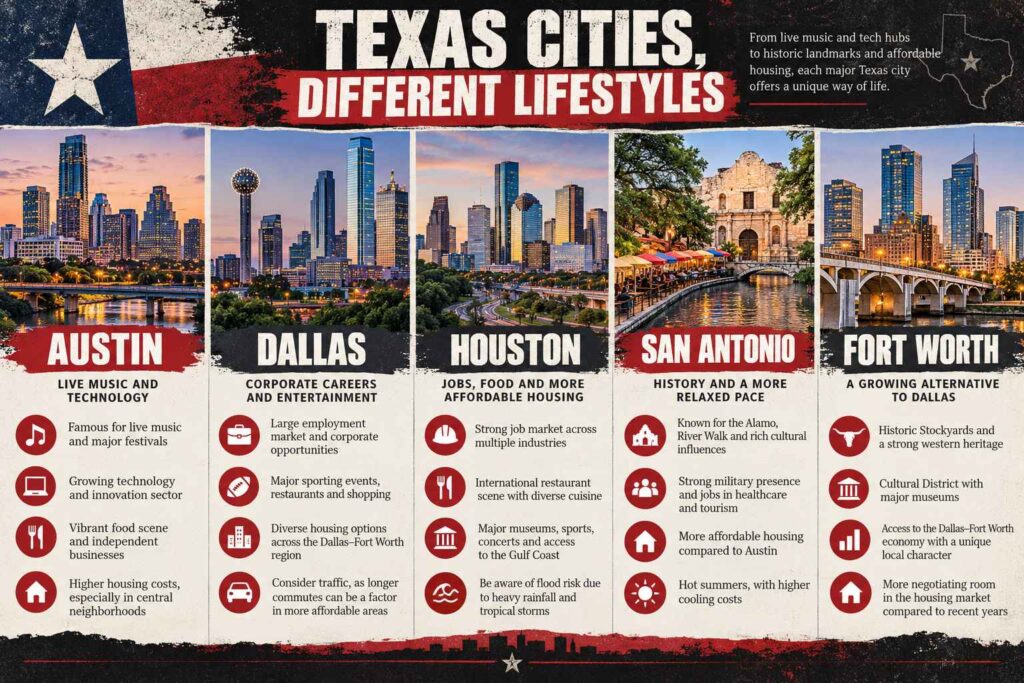
Moving to Austin means something quite different from settling in Houston or San Antonio. The cities have separate employment markets, entertainment scenes, and housing conditions.
Austin For Live Music And Technology
Austin has a long reputation for live music, with concerts taking place in clubs, bars, theaters, and larger venues throughout the city. South by Southwest and Austin City Limits Music Festival have helped attract national and international attention to the local entertainment scene.
Neighborhoods around South Congress and East Austin offer restaurants, independent businesses, and places to hear live performances. However, Austin is also one of the more expensive major Texas metropolitan areas. The rapid housing boom of earlier years has cooled, but popular central neighborhoods remain costly.
Austin’s music culture also depends on independent record stores, guitar shops, and studios, reflecting the wider importance of local music businesses in supporting artists and their communities.
Dallas For Corporate Careers And Entertainment
Dallas appeals to people interested in a large employment market, major sporting events, restaurants, shopping, and urban entertainment.
The wider Dallas-Fort Worth region includes communities with very different housing markets, from expensive established neighborhoods to more affordable suburbs farther from the main business districts. Traffic is an important consideration. A cheaper house located far from work can result in a lengthy daily commute.
Houston For Jobs, Food, And More Affordable Housing
Houston has an enormous metropolitan area with neighborhoods that vary considerably in price and character. The city is famous for its international restaurant scene, with food influenced by its large and diverse population.
Houston also offers major museums, professional sports, concerts, and access to the Gulf Coast. Homebuyers should pay particular attention to flood exposure. Heavy rainfall and tropical storms have caused substantial damage in the region, and flood risk can vary considerably between nearby properties.
San Antonio For History And A More Relaxed Pace
San Antonio is known for the River Walk, the Alamo, and its strong Mexican and Texan cultural influences. The city also has a substantial military presence and employment opportunities in healthcare, tourism, and related industries.
Housing tends to be less expensive than in the Austin metropolitan area, making San Antonio attractive to buyers who want a large city without paying Austin prices. Summer temperatures can be intense, and residents should account for the cost of cooling their homes.
Fort Worth Is Becoming An Attractive Alternative To Dallas
Fort Worth offers access to the larger Dallas-Fort Worth economy but has a character of its own. The Stockyards National Historic District celebrates the city’s cattle industry, while the Cultural District contains major museums such as the Kimbell Art Museum and the Modern Art Museum of Fort Worth.
Visitors and residents can also enjoy restaurants, concerts, professional sports across the wider metropolitan area, and the nearby attractions of Arlington. Fort Worth reached a population of more than one million residents in 2025, making it one of the ten largest cities in the United States.
According to Zillow, the typical home value is $292,949 in 2026, down 1.6% from the previous year. The median sale price in August 2026 was $326,000, while the median listing price in September was $338,167.
Homes took a median of 32 days to go pending, and 56.4% of sales in August closed below the asking price. Buyers may therefore have more negotiating room than during the period when homes in some Texas markets were attracting multiple offers shortly after being listed.
Still, Fort Worth contains neighborhoods with substantially higher property values. The price of a house depends on its size, condition, age, and proximity to employment centers.
Anyone preparing to buy or sell should also account for ordinary household repairs, including air conditioning maintenance, plumbing inspections, water heater repair in Fort Worth, and similar work that may need attention before a property changes hands.
Texas Home Prices Are No Longer Rising Everywhere
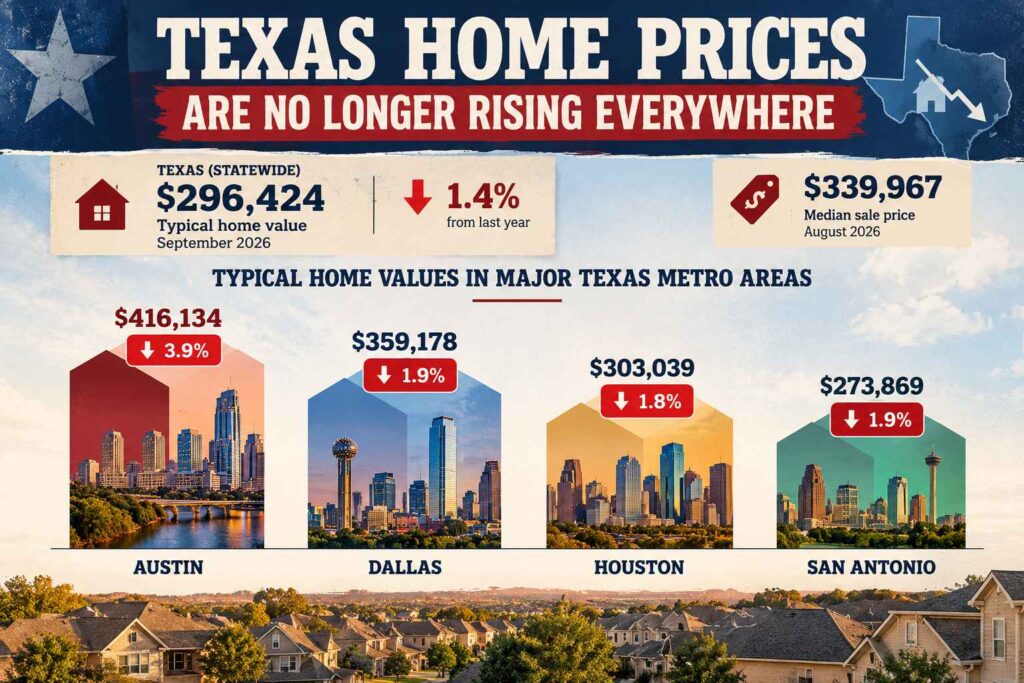
Texas housing prices have cooled since the intense buying activity of the pandemic period.
According to Zillow’s statewide housing figures, the typical Texas home value was $296,424 in September 2026, down 1.4% from a year earlier.
The statewide median sale price in August was $339,967.
Several major metropolitan areas have also recorded annual price declines, although prices remain well above pre-pandemic levels in many neighborhoods.
Typical Home Values In Major Texas Metropolitan Areas
| Metropolitan Area | Typical Home Value, September 2026 | Annual Change |
| Austin | $416,134 | -3.9% |
| Dallas | $359,178 | -1.9% |
| Houston | $303,039 | -1.8% |
| San Antonio | $273,869 | -1.9% |
The figures come from Zillow’s September 2026 housing market report and cover metropolitan areas rather than individual city boundaries.
Austin remains the most expensive of the four metropolitan areas listed, but it has also experienced the largest annual decline.
For buyers, falling prices may create opportunities to negotiate. However, mortgage interest rates influence monthly affordability just as much as the purchase price.
Someone buying a cheaper house with a much higher mortgage rate than they previously had could still face a larger monthly payment.
What It Really Costs To Buy A Home In Texas
Consider a family purchasing a $350,000 house with a 20% down payment.
The down payment would be $70,000, leaving a mortgage of $280,000.
At an illustrative 6.5% interest rate on a 30-year fixed mortgage, monthly principal and interest would be about $1,770.
Property taxes, homeowners insurance, utilities, and maintenance would increase the monthly cost.
In some newly developed communities, buyers may also encounter homeowners association fees or special district taxes.
View this post on Instagram
Home Maintenance Can Be More Expensive Than Newcomers Expect
Texas heat puts substantial demands on air conditioning systems. A house that needs major HVAC repairs can become expensive to maintain, especially during the summer.
Homeowners also need to watch for roof damage following hailstorms, plumbing problems, foundation movement, and drainage issues.
Before buying, ask the seller about the age and condition of major household systems. A professional inspection can identify visible problems, although it does not guarantee that every future repair will be discovered.
Homeowners should also understand the essentials to deal with after buying a house, especially when planning repairs, maintenance, and other early expenses.
For sellers, dealing with known repair problems before listing can reduce the risk of difficult negotiations after a buyer’s inspection.
The Weather Is Warm, But Texas Summers Are Demanding
People moving from northern states may appreciate the relatively mild winters across much of Texas.
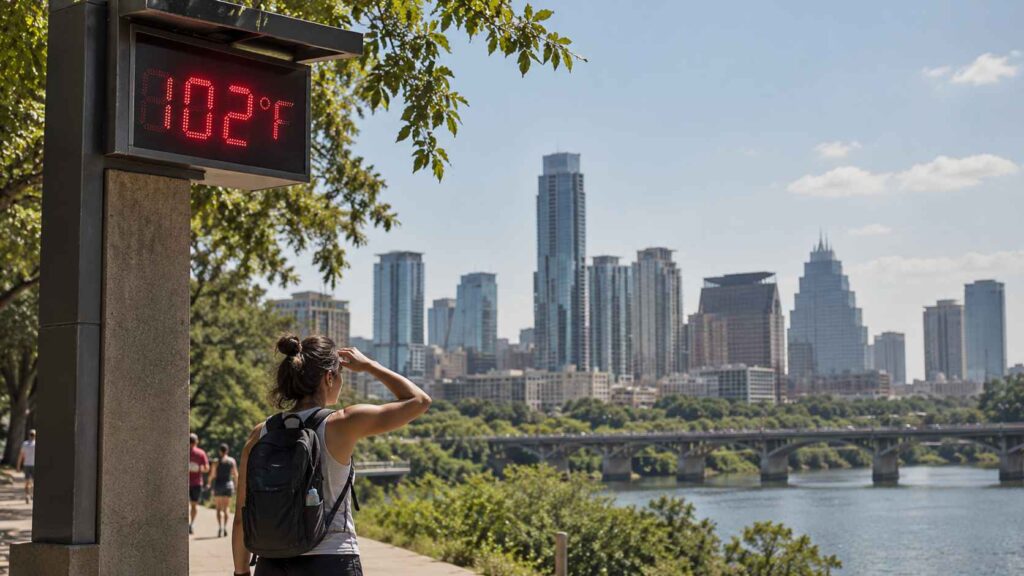
However, summer temperatures can make outdoor activities uncomfortable, particularly during prolonged heat waves.
Dallas, Austin, Houston, and San Antonio can all experience very hot weather, with humidity adding to the discomfort in some regions.
Air conditioning is essential for comfortable indoor living during much of the warmer season.
Texas also experiences severe thunderstorms, hail, tornadoes, and flooding. Coastal areas face additional risks from hurricanes and tropical storms.
Weather conditions vary significantly across such a large state. West Texas has a drier climate, while Houston and the Gulf Coast experience higher humidity and greater exposure to tropical weather systems.
Prospective homeowners should examine local climate risks and obtain insurance quotations before committing to a property.
Is Moving To Texas Still Worth It In 2026?
Texas continues to offer employment opportunities, relatively affordable housing in many areas, and access to major cities with established cultural identities.
The absence of a personal state income tax can be particularly attractive to higher earners moving from states with substantial income tax rates.
Austin may suit someone who enjoys live music and works in technology. Houston offers a larger and more varied employment market, while San Antonio and Fort Worth can appeal to buyers who want comparatively lower housing prices.