

Stay with us and find out where the next one takes us.
- 10 Most Expensive Guitars Ever Sold, Including the One Kurt Cobain Played on MTV Unplugged - November 10, 2026
- How Small Businesses Can Use 3D Printing to Develop New Products - November 9, 2026
- Who Makes the Most Money at Music Festivals, Artists or Organizers? - November 6, 2026
A small business owner has an idea for a new product. It might be a phone accessory, a custom guitar stand or a clever kitchen tool. The design looks promising on paper, but paying a manufacturer to produce hundreds of units before anyone has tested it is a considerable financial risk.
3D printing offers another approach. Businesses can turn digital designs into physical objects, test them with customers and improve the product before committing to larger manufacturing orders.
The technology has become especially useful for entrepreneurs who want to develop original products without maintaining expensive manufacturing equipment. Small companies can work with external printing services, experiment with different materials and produce limited quantities when demand is uncertain.
However, successful product development requires more than purchasing a printer and downloading design software. Choosing suitable products, calculating expenses and testing actual performance are equally important.
Start by Turning a Product Idea Into a Physical Prototype
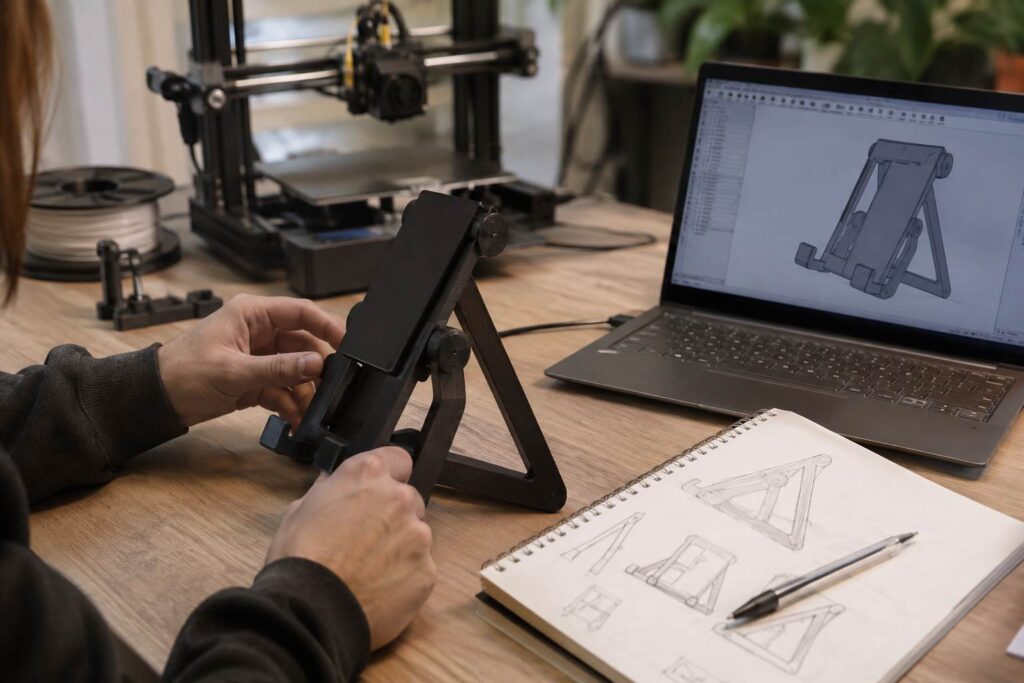
Imagine a company developing an adjustable stand for musicians who use tablets to display sheet music. The initial design looks attractive on a computer screen, but nobody knows how stable it will feel when holding a tablet.
A 3D printed prototype allows the business to test the design before investing in commercial production.
Employees can assemble the stand, adjust its moving parts and check its dimensions. If the tablet sits at an uncomfortable angle or the adjustment mechanism feels awkward, the designer can modify the digital model and produce another version.
The National Institute of Standards and Technology identifies rapid prototyping as an important benefit of additive manufacturing. Businesses can create and revise designs without paying for dedicated production molds during the early development stages.
For small companies, that flexibility can prevent expensive mistakes. Discovering a design problem after producing five prototypes is generally less costly than discovering it after ordering 5,000 finished products.
The same approach applies to businesses developing much smaller, more complex products. For example, electronics manufacturers working with miniature sensors or precision components may explore technologies such as capillary force micro-printing.
This specialized process uses tiny deposits of functional inks to produce extremely detailed patterns, allowing manufacturers to work at scales that conventional desktop 3D printers cannot achieve.
Choose Products That Actually Benefit From 3D Printing
Not every product is suitable for additive manufacturing. Simple objects produced in enormous quantities may be cheaper to manufacture using conventional processes.
However, custom products, complicated shapes and replacement components can be particularly interesting opportunities.
| Business Type | Potential 3D Printed Product | Why It May Work |
| Music equipment retailer | Custom cable organizers and instrument accessories | Designs can accommodate different equipment sizes. |
| Home organization brand | Drawer dividers and specialized storage holders | Products can be adjusted for unusual spaces. |
| Electronics business | Protective enclosures and mounting brackets | Prototypes can be tested with actual electronic components. |
| Independent artist | Custom display stands and collectible merchandise | Limited quantities can be produced without large inventory commitments. |
| Small manufacturing workshop | Assembly guides, fixtures and positioning tools | Custom equipment can improve repetitive workshop tasks. |
Some of the most commercially useful applications are ordinary objects that solve specific problems. A replacement clip for an older device or a mounting bracket designed for an unusual workspace may be more valuable to a particular customer than another decorative product.
Businesses should begin with a problem customers already experience. A convincing product idea needs a clear purpose before it needs an impressive design.
Test Different Materials Before Choosing the Final Design
A 3D printed object can look excellent and still fail during everyday use. Materials behave differently under pressure, heat, sunlight and repeated movement.
For example, a decorative desk organizer does not need the same properties as a clip that repeatedly bends or a component installed inside a warm vehicle.
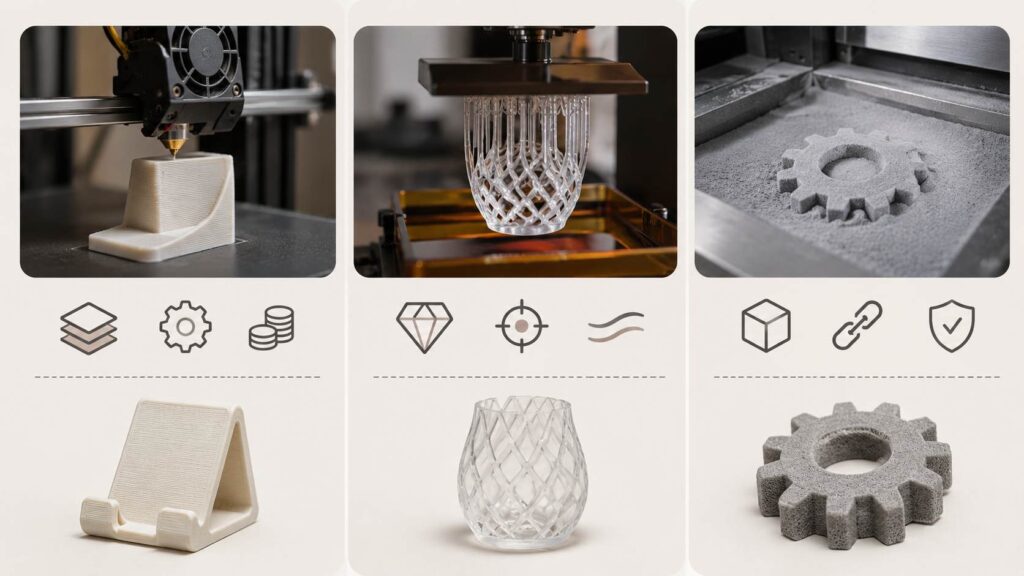
- Fused filament fabrication: Uses heated plastic filament to build objects in layers. It is widely used for basic prototypes, holders and functional parts.
- Resin printing: Uses light to cure liquid resin. Suitable processes can produce fine details and smooth surfaces, although material handling and finishing require additional care.
- Powder bed printing: Technologies such as selective laser sintering can produce complex functional components without the same support structures required by some other methods.
Businesses should test materials under conditions similar to actual product use. A bracket intended for outdoor equipment needs suitable weather resistance. A component that supports weight should undergo appropriate mechanical testing.
Printed prototypes do not automatically demonstrate that a product will meet safety requirements or perform reliably over time. Products involving electrical systems, food contact, children or medical applications may require additional testing and regulatory compliance.
Explore the Possibilities of Precision Micro-Printing
Some product ideas require details much smaller than ordinary desktop printers can produce. Electronics, miniature sensors and advanced components may depend on precisely deposited materials at microscopic scales.
One emerging approach is capillary force micro-printing. The high precision capillary printing process uses a tiny oscillating pen and capillary forces to deposit specialized inks onto surfaces.
This technology can create patterns at micrometer and submicrometer scales, with applications in electronics, semiconductors and sensors.
Use Small Production Runs to Find Out What Customers Want
Producing a prototype proves that an object can be made. Selling it proves something different.
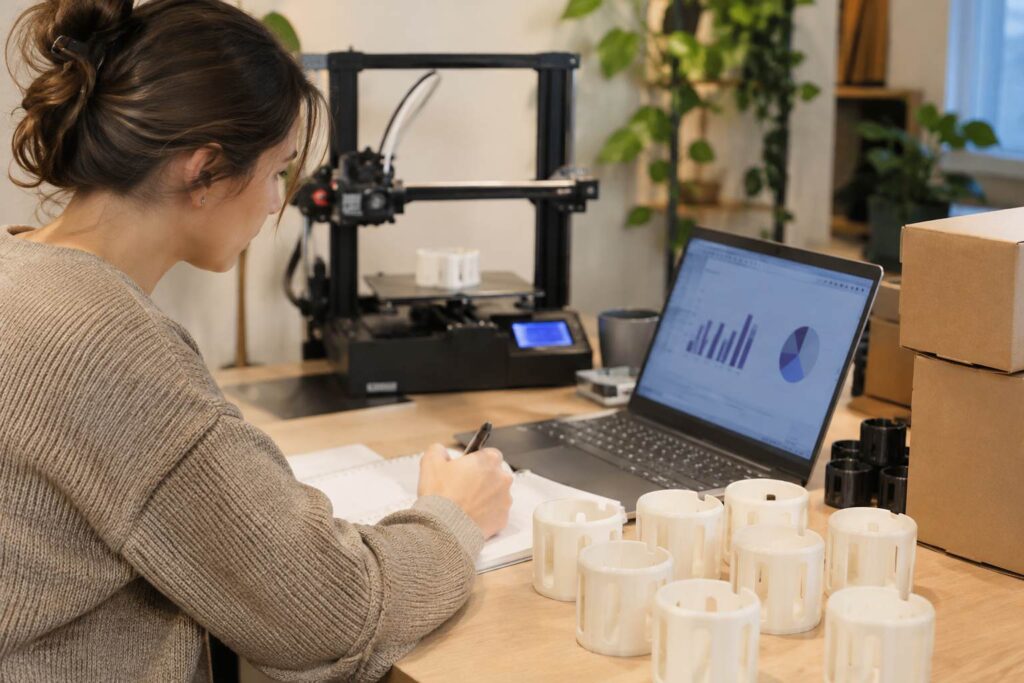
Before ordering large quantities, small businesses can use 3D printing to produce a limited batch and measure customer interest.
Consider an independent musician developing a custom desktop display for collectible concert memorabilia. Instead of commissioning hundreds of units, the musician could produce a small collection, photograph the finished products and offer them to existing fans.
Customer responses could reveal which dimensions, colors and finishes are most appealing. The business could also discover that buyers prefer a smaller product with a lower selling price.
For artists developing merchandise, it helps to consider which band merchandise retains collectible value. Original designs, limited availability and product quality can influence interest, although no collectible is guaranteed to increase in value.
During a small launch, businesses should record actual sales rather than relying entirely on compliments or social media reactions.
Useful questions include how many products sold, which versions customers selected, how much packaging and shipping cost, and how many buyers requested refunds or replacements.
Positive feedback is encouraging, but repeat purchases and profitable orders provide stronger evidence that the product has commercial potential.
Calculate the Real Cost of Every Printed Product
Plastic filament may seem inexpensive, but material cost is only one part of producing a finished item.
Printer operating time, electricity, equipment depreciation, failed prints, cleaning, finishing and packaging all affect the final cost.
Consider the following hypothetical production example for a small desktop accessory.
| Production Expense | Cost per Item |
| Printing material, including waste | $5.00 |
| Printer operation and equipment allocation | $5.00 |
| Finishing labor | $6.00 |
| Packaging | $1.50 |
| Allocated overhead | $2.00 |
| Total estimated production cost | $19.50 |
If the business sells the accessory for $35, the difference is $15.50 before transaction fees, shipping subsidies, taxes and other expenses not included in the example.
The calculation also excludes initial design development costs. A product that requires extensive modeling and repeated testing will need enough sales to recover that investment.
Printing a product cheaply does not automatically mean selling it profitably. Entrepreneurs should calculate the cost of a finished, packaged item rather than focusing only on the amount of plastic used.
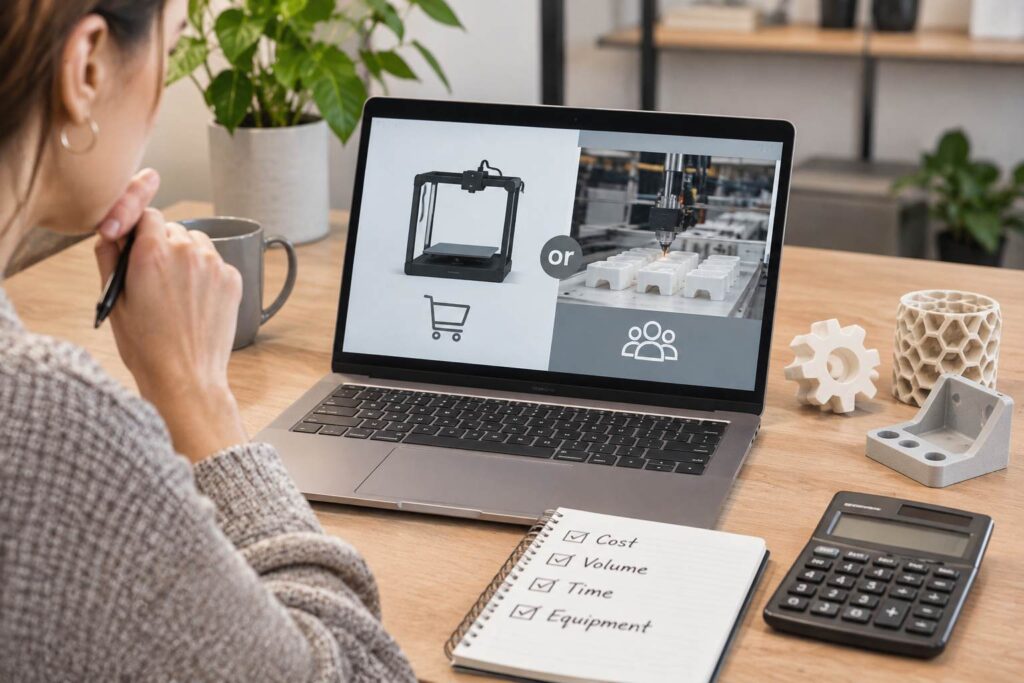
Decide When to Outsource Instead of Buying a Printer
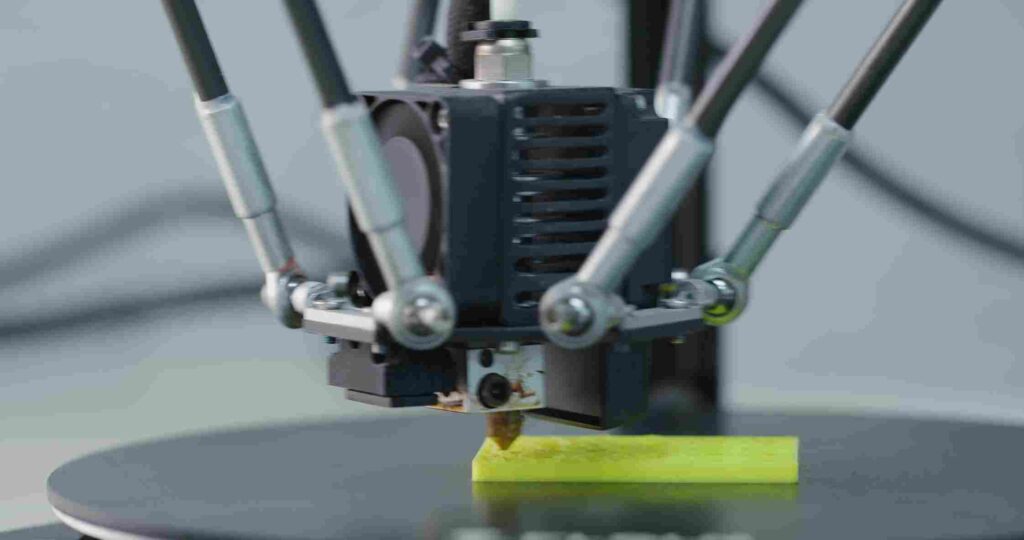
A desktop 3D printer can be an attractive purchase for businesses planning frequent product development. However, ownership introduces responsibilities that are easy to underestimate.
Printers need maintenance, suitable materials, technical knowledge and space. Failed prints consume time, and some processes require additional cleaning or curing equipment.
There are also workplace safety considerations. The National Institute for Occupational Safety and Health identifies potential exposure to particles, chemicals and other hazards during additive manufacturing. Appropriate ventilation, material handling and equipment safeguards depend on the printing process.
For a business producing only a few prototypes each month, an external printing service may be more economical.
Outsourcing can also provide access to industrial printing technologies without purchasing specialized machines. Business owners should compare quotes based on material, dimensions, surface finish, tolerances and delivery time.
Companies developing products regularly may eventually benefit from owning equipment, especially when repeated design changes make outsourcing slow or expensive.
Know When 3D Printing Is No Longer the Cheapest Option
3D printing can be economical for prototypes and small production runs because manufacturers do not need to create a dedicated mold for every design.
However, producing hundreds or thousands of identical plastic parts may change the calculation.
Injection molding requires an initial investment in tooling, but the cost per item can decrease substantially when production quantities become large.
According to the Protolabs manufacturing comparison, 3D printing is generally well suited to rapid design changes and lower production volumes, whereas injection molding can offer lower unit costs for large quantities of consistent parts.
The right decision depends on product complexity, material, size, required precision and production volume. There is no universal quantity at which one method automatically becomes cheaper.
A small business might print its first ten prototypes, manufacture 100 units for an initial product launch and later move to injection molding after demand becomes predictable.
Even after switching production methods, 3D printing can remain useful for developing new accessories, testing improvements and creating manufacturing fixtures.
Start With One Product That Solves a Real Problem
3D printing gives smaller companies opportunities to create physical products without making enormous manufacturing commitments at the beginning.
However, the greatest advantage is the ability to test ideas before investing heavily in them. A business can discover that a product needs a different shape, a better material or a completely new purpose before spending money on large production orders.
Choose one promising idea, develop a working prototype and let potential customers test it. Record what needs improvement and calculate the cost of producing a finished item.
If customers find the product useful and the numbers support commercial production, the business has a concrete foundation for its next step. A successful launch might begin with an ordinary plastic prototype, but the information gained through testing can be far more valuable than the first printed object.