
Stay with us and find out where the next one takes us.
- How Much Does It Cost to Make a Music Video? - October 19, 2026
- 8 Future Classic Cars Worth Buying Before Prices Start Rising - October 19, 2026
- 7 Celebrities Who Actually Look Better After Plastic Surgery - October 19, 2026
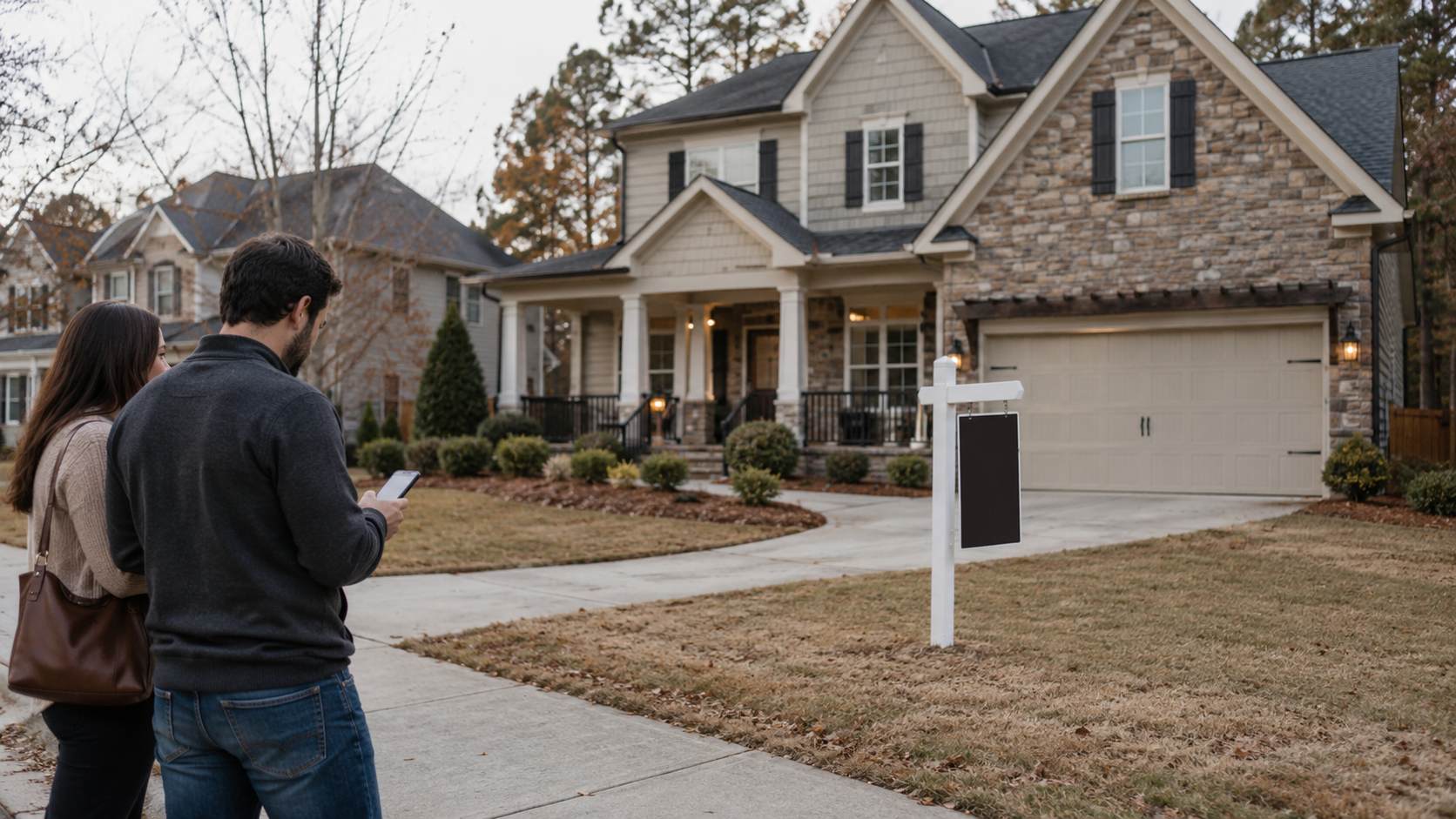
A house listed for $425,000 in suburban Atlanta might have attracted multiple offers within days a few years ago. In 2026, the same seller may be looking at several weeks on the market, a price reduction and buyers asking for help with closing costs.
Georgia has entered a considerably slower housing market. More properties are available, buyers have time to inspect homes properly, and sellers can no longer assume that every reasonably priced listing will attract immediate attention. Unfortunately, borrowing money has also become more expensive.
As of October 15, the average 30-year mortgage rate had climbed to 7.40%, making monthly payments considerably higher than earlier in the year. Georgia home prices, meanwhile, have shown relatively little statewide movement compared with 2025.
For someone planning to buy a house, the opportunity depends heavily on location. A family searching in Gwinnett County faces a different market from someone looking near downtown Atlanta, and neither market tells you much about buying a coastal property in Savannah.
Georgia Housing Market in 2026, What the Latest Numbers Show
Georgia is no longer experiencing the frantic buying activity associated with the pandemic housing boom. More homes are sitting on the market, and the latest figures indicate that sellers have lost some of their negotiating advantage.
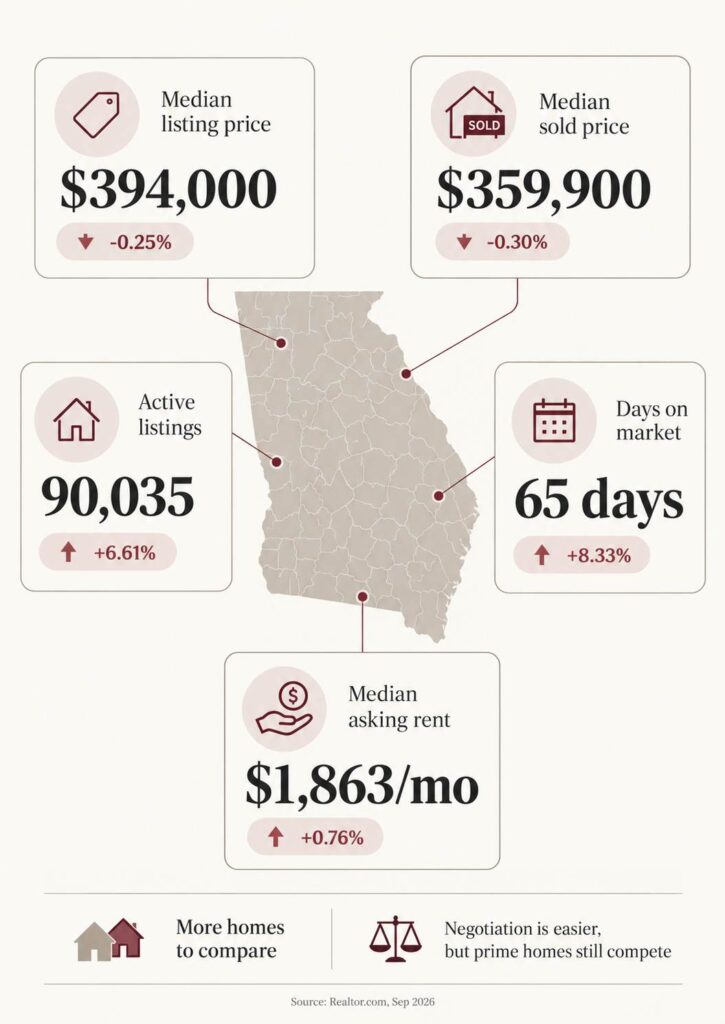
According to Realtor.com, the statewide median listing price was $394,000, down 0.25% from a year earlier. The median sold price was $359,900, down 0.30%.
There were 90,035 active listings across Georgia, representing a 6.61% annual increase. Properties spent a median of 65 days on the market, compared with a shorter selling period one year earlier.
| Housing Market Indicator | September 2026 | Annual Change |
| Median listing price | $394,000 | -0.25% |
| Median sold price | $359,900 | -0.30% |
| Active listings | 90,035 | +6.61% |
| Median days on market | 65 days | +8.33% |
| Median asking rent | $1,863 per month | +0.76% |
Source: Realtor.com, September 2026. Figures cover the Georgia market and include residential property types rather than detached houses alone.
For buyers, the rise in available homes means more opportunities to compare properties and negotiate. A house that has remained unsold for two months deserves a closer look at its listing history, particularly if similar properties nearby have sold for less.
Higher inventory does not mean every home is suddenly a bargain. Well-maintained houses in desirable school districts can still attract competition, especially when sellers have priced them according to recent comparable sales.
Atlanta Is Selling Fewer Homes Than a Year Ago
The Atlanta metropolitan area provides another clear example of the slowdown.
Data published by Georgia Multiple Listing Service shows that 5,143 residential properties sold across the 29-county Atlanta metropolitan area in September 2026, compared with 5,811 in September 2025.
That represents an 11.50% annual decline in transactions. Meanwhile, the median sale price remained almost unchanged at $387,500.
Atlanta also had 28,259 active listings and 4.94 months of housing inventory. A year earlier, inventory stood at 4.72 months.
A homeowner hoping to sell quickly now faces more competition from neighboring listings. Buyers, on the other hand, have greater opportunity to negotiate inspection repairs, closing-cost assistance or a lower purchase price.
Mortgage Rates Are Making Georgia Homes More Expensive to Own
The biggest obstacle facing Georgia homebuyers in October 2026 is the cost of borrowing.
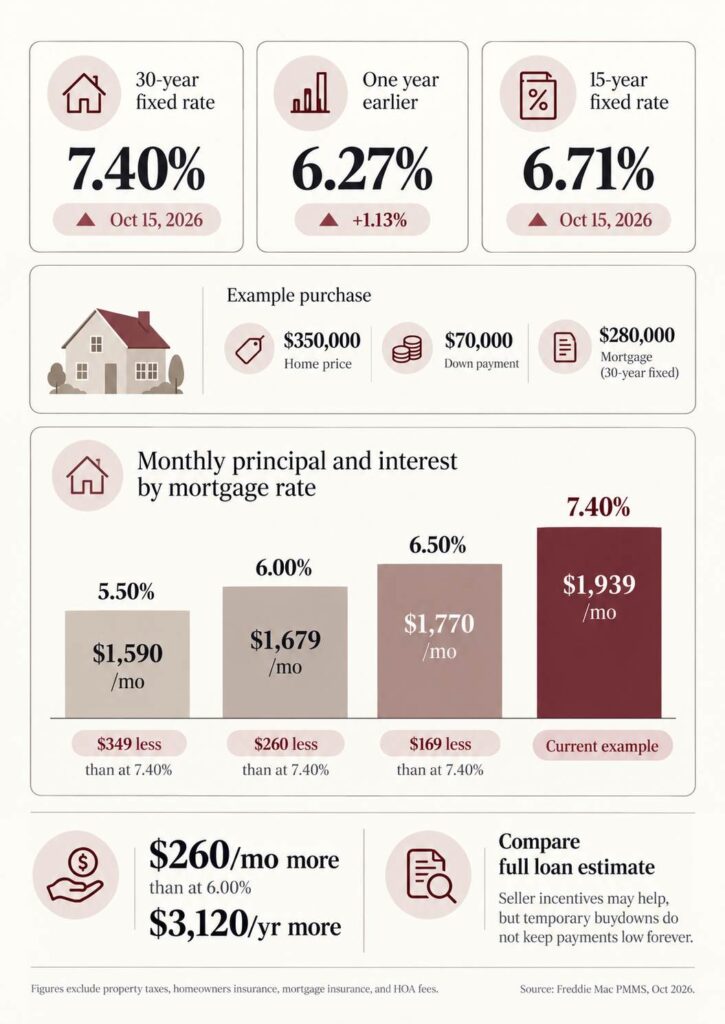
Freddie Mac reported that the average 30-year fixed mortgage rate reached 7.40% on October 15, compared with 6.27% one year earlier. The 15-year fixed mortgage rate stood at 6.71%.
The figures are published in Freddie Mac’s weekly mortgage survey, which tracks national loan offers for borrowers with strong credit and a 20% down payment.
A relatively small movement in interest rates can substantially increase the cost of buying a home.
Monthly Payment on a $350,000 House
Consider a buyer purchasing a $350,000 home in Georgia with a $70,000 down payment. The remaining mortgage would be $280,000, financed over 30 years.
| Mortgage Rate | Monthly Principal and Interest | Monthly Difference From 7.40% |
| 5.50% | $1,590 | $349 less |
| 6.00% | $1,679 | $260 less |
| 6.50% | $1,770 | $169 less |
| 7.40% | $1,939 | Current example |
Figures are rounded calculations for a 30-year fixed mortgage of $280,000. They exclude property taxes, homeowners insurance, mortgage insurance and homeowners association fees.
At 7.40%, the buyer would pay $260 more each month than at 6.00%. Over twelve months, that is $3,120 in additional payments before considering other ownership expenses.
Some sellers are responding to high mortgage rates by offering temporary rate buydowns or contributing toward closing costs. Builders may also advertise financing incentives through preferred lenders.
Buyers should compare the full loan estimate, including fees and the rate after any temporary discount expires. A low advertised payment for the first year does not mean the mortgage will remain inexpensive.
Should You Wait for Mortgage Rates to Fall?
Waiting could save money if rates decline, but the timing is uncertain. Mortgage rates respond to inflation expectations, Treasury yields and wider financial conditions. A Federal Reserve interest-rate cut does not guarantee an equivalent reduction in 30-year mortgage rates.
Buyers should also consider their local housing market. If borrowing becomes cheaper, more households may qualify for mortgages and begin competing for the same properties.
Someone with reliable income, adequate savings and a plan to remain in the home for several years may find a suitable opportunity today. A buyer whose budget only works after a substantial future rate reduction is taking a much greater financial risk.
Where to Buy a House in Georgia in 2026
Georgia contains 159 counties, and housing conditions can change considerably across the state. Even within metropolitan Atlanta, prices vary between established neighborhoods, newer suburban developments and areas farther from major employment centers.
County-level sales provide a useful starting point, although buyers should still compare individual neighborhoods and homes of similar size and condition.
Georgia County Home Prices in September 2026
| County | Median Sale Price | Annual Price Change | Active Listings |
| Fulton | $455,000 | +12.3% | 5,660 |
| Cobb | $417,750 | +0.5% | 2,799 |
| Gwinnett | $410,000 | -0.5% | 3,597 |
| Hall | $407,000 | -3.7% | 1,155 |
| DeKalb | $360,500 | +3.6% | 2,921 |
Source: Georgia Multiple Listing Service county market reports for September 2026. Median prices describe properties sold during the reporting month, not the value of every house in each county.
Fulton County, Atlanta and Its Northern Suburbs
Fulton County includes much of Atlanta, along with northern communities such as Alpharetta, Roswell and Sandy Springs. Buyers can find everything from downtown condominiums to large suburban houses, although prices are highly dependent on the neighborhood.
The September Fulton County sales report recorded a median sale price of $455,000, up 12.3% from September 2025.
However, only 797 residential properties sold during the month, compared with 990 one year earlier. The sharp rise in the median should not be interpreted as every house increasing in value by the same percentage. Changes in the mix of expensive and inexpensive homes sold can influence a county median.
People working in Midtown, Buckhead or other central Atlanta employment districts may prefer a shorter commute, even if the purchase price is higher. Households with flexible working arrangements have more freedom to search farther north, where the balance between lot size, school access and commute time can be more attractive.
Cobb County, Marietta, Smyrna and Kennesaw
Cobb County remains a popular area for buyers seeking suburban housing with access to Atlanta. Marietta offers established neighborhoods and a historic town square, Smyrna provides convenient access to the Cumberland area, and Kennesaw attracts buyers looking near Kennesaw State University and the I-75 corridor.
Georgia MLS figures for Cobb County shared that the median residential sale price reached $417,750 in September, up just 0.5% from the previous year.
There were 2,799 active listings, compared with 2,423 in September 2025. Sales declined from 668 to 622 over the same period.
For a buyer, the additional properties provide more opportunities to compare renovated homes with houses that still need work. In established neighborhoods, the roof age, HVAC condition and foundation deserve close inspection before deciding that an older property is a bargain.
View this post on Instagram
Gwinnett County, Norcross, Duluth and Lawrenceville
Gwinnett County deserves serious consideration from buyers looking northeast of Atlanta. It includes Norcross, Duluth, Lawrenceville, Suwanee, Lilburn and several other established suburban communities.
The county offers access to major commercial corridors, employment centers and a wide selection of housing built across several decades. Prices vary considerably between older neighborhoods and newer subdivisions.
According to the Gwinnett County report, the median sale price was $410,000, down 0.5% from September 2025.
The number of homes sold declined by 17%, from 794 to 659. Active listings increased 14.9% to 3,597.
Those numbers suggest buyers have more properties to consider and fewer competing transactions than a year earlier. However, a home near a desirable school or employment center may still command a premium.
Norcross Offers Established Neighborhoods and Older Homes
Norcross is particularly interesting for buyers who prefer established neighborhoods over newly constructed subdivisions. The historic downtown area includes older homes near local shops and restaurants, while surrounding communities offer a wider selection of suburban properties.
Older houses can offer mature trees, established streets and architectural details missing from many newer developments. They can also come with aging water pipes, sewer lines or electrical systems that are expensive to replace.
Homeowners preparing to sell should address significant maintenance problems before inviting potential buyers to tour the property. A leaking pipe or sewage backup can create concerns during inspection and lead to repair negotiations or a delayed sale.
If a Norcross property develops a serious plumbing problem shortly before a showing or closing, contacting an Emergency Plumber in Norcross can help address the immediate issue and limit further water damage. Roof leaks, electrical faults and HVAC failures also deserve prompt professional attention, since unresolved repairs can influence the price buyers are willing to offer.
DeKalb County, Decatur and the Eastern Atlanta Suburbs
DeKalb County provides another set of possibilities for buyers interested in the eastern side of metropolitan Atlanta. The county includes communities ranging from densely developed areas near Atlanta to more suburban neighborhoods farther east.
Decatur is known for its downtown restaurants, independent shops and access to MARTA rail service. Houses within the city of Decatur can command considerably higher prices than properties elsewhere in the county, so a countywide median has limited value when comparing individual neighborhoods.
The latest report for DeKalb recorded a median price of $360,500, up 3.6% year over year.
Sales fell from 681 to 547, a decline of 19.7%. Active listings were also down 14.6%, indicating that the county has not experienced the same annual inventory increase reported in Gwinnett or Cobb.
Buyers looking at older DeKalb properties should investigate drainage, foundation conditions and previous renovations. In neighborhoods with mature trees, sewer-line inspections can also be useful, especially when a house has an older plumbing system.
Hall County, Gainesville and Lake Lanier
For buyers who want more distance from central Atlanta, Hall County offers a combination of established housing, newer construction and properties near Lake Lanier.
Gainesville is the principal city, with employment in healthcare, manufacturing and other local industries. Lakefront and lake-access homes can be considerably more expensive than inland properties, so the county median should be treated as a general reference.
The Hall County market report recorded a median sale price of $407,000, down 3.7% from one year earlier. Sales were unchanged at 215 homes, while active inventory increased 6.4%.
Lakefront buyers should examine shoreline conditions, dock permits, insurance costs and flood exposure before making an offer. A relatively affordable asking price can conceal substantial expenses associated with waterfront ownership.
Atlanta, Savannah, Augusta or a Smaller Georgia City?

Not every buyer wants to live within commuting distance of Atlanta. Georgia has several separate housing markets, each influenced by local employment, population growth and the available housing stock.
Atlanta Has More Jobs, but Housing Costs Are Higher
Metro Atlanta remains the economic center of Georgia, with major employers in technology, logistics, healthcare, professional services and transportation.
The region also offers professional sports, entertainment venues, universities and access to Hartsfield-Jackson Atlanta International Airport.
However, buyers should calculate commuting expenses before paying extra for a large suburban house. A property located far from work may reduce the purchase price but increase fuel expenses and the number of hours spent driving each week.
Savannah Has Coastal Appeal and Additional Insurance Concerns
Savannah attracts people interested in historic architecture, tourism, port-related employment and coastal living. The city also has neighborhoods with older housing that require specialized maintenance.
Anyone considering a property in Savannah or nearby coastal communities should examine flood zones, insurance requirements and hurricane-related risks before making an offer.
The FEMA Flood Map Service Center allows buyers to look up official flood hazard information for a property address. Insurance quotations should also be obtained before the inspection period expires.
Homes outside designated high-risk flood zones can still experience flooding, so an address-level assessment is more informative than relying solely on the neighborhood name.
Augusta and Other Regional Cities Deserve Consideration
Augusta, Columbus, Macon and Warner Robins offer alternatives for buyers who do not need access to the Atlanta employment market.
Augusta has major healthcare institutions, military employment and the nationally recognized Masters Tournament. Columbus benefits from its connection to Fort Benning, while Warner Robins has a substantial aerospace and defense-related employment base.
Households relocating for work should compare local wages with housing expenses. A lower purchase price is less attractive if the move also produces a significant reduction in household income.
Smaller markets may also have fewer comparable properties available for sale, making professional appraisals and careful pricing particularly important.
How Much Money Do You Need to Buy a House in Georgia?

The down payment is only one part of the cash needed to purchase a property. Buyers must also plan for closing costs, inspections, prepaid insurance and immediate repairs.
Consider a $350,000 home purchased with a 5% down payment.
| Purchase Expense | Illustrative Cost |
| Home price | $350,000 |
| Down payment at 5% | $17,500 |
| Mortgage principal | $332,500 |
| Closing costs at 3% | $10,500 |
| Cash for down payment and closing | $28,000 |
The closing-cost percentage is an illustrative assumption. Actual lender fees, title charges, taxes and prepaid expenses vary by transaction. The example also excludes moving costs, inspections, repair reserves and any seller credits.
At a 7.40% interest rate, the $332,500 mortgage would generate a monthly principal and interest payment of around $2,302 on a 30-year term. Property taxes, insurance and any required mortgage insurance would increase the total.
A buyer with a small down payment should obtain a detailed loan estimate rather than relying on an online mortgage payment that excludes these expenses.
Georgia Dream Can Help Eligible Homebuyers
Georgia offers homeownership assistance through the Georgia Department of Community Affairs. The Georgia Dream mortgage programs provide financing and down payment assistance for qualifying borrowers.
Under rules effective July 8, 2026, the standard Georgia Dream program lists a maximum home price of $625,000 and income limits of $137,555 for one- or two-person households and $158,188 for households of three or more, subject to applicable program and location rules.
Other products, including Peach Plus and Peach Advantage, have separate eligibility requirements and higher permitted home prices.
Down Payment Assistance Is Not Always Free Money
Buyers should examine the repayment terms before accepting assistance.
Georgia Dream down payment assistance is generally provided through a second mortgage with a 0% interest rate and no monthly payment. The state homeownership guidance explains that the assistance must be repaid when the property is sold, refinanced or transferred.
The second mortgage reduces the money required at closing, but it does not automatically disappear after several years.
Is It Better to Buy or Rent in Georgia Right Now?
Georgia renters are facing a substantially different calculation from people who already own homes with mortgages secured several years ago.
The statewide median asking rent was $1,863 per month in September 2026. Meanwhile, purchasing a median-priced home with a mortgage at current rates may produce a principal and interest payment that exceeds the rent before taxes, insurance and maintenance are included.
However, median rents and median home prices do not describe equivalent properties. Comparing a two-bedroom apartment with a four-bedroom detached house would exaggerate the financial disadvantage of buying.
A meaningful comparison requires rental and purchase options in the same neighborhood, with similar space and amenities.
Buying Makes More Financial Sense for Long-Term Residents
Purchasing can be attractive for households planning to stay in the same community for several years. Monthly mortgage payments gradually reduce the loan balance, and owners have greater freedom to renovate or modify their properties.
However, the early years of a 30-year mortgage are heavily weighted toward interest. At a 7.40% rate, principal builds slowly compared with a loan carrying a much lower interest rate.
Selling after only two or three years can be expensive once transaction costs and any necessary repairs are considered.
Renting Gives Buyers Time to Improve Their Finances
Someone planning to relocate again within a short period may be better served by renting, particularly if employment or family circumstances are uncertain.
Renting can also create time to improve a credit score, reduce existing debt and accumulate a larger down payment. Those changes may improve mortgage eligibility and reduce financing expenses.
Waiting simply because someone expects home prices to collapse is a separate decision. Georgia data through September 2026 shows a slower market, but it does not establish that a major statewide price decline is imminent.
What Buyers Should Negotiate Before Signing a Contract

More available homes and slower sales have given buyers room to ask for concessions, although local conditions and the appeal of a particular property still determine how much negotiating power they have.
1. Ask for Seller Contributions Toward Closing Costs
A seller who does not want to reduce the advertised price may agree to contribute toward eligible closing expenses.
For example, a seller contribution of $7,000 could reduce the upfront cash needed to complete the transaction. The amount allowed depends on the loan program, purchase terms and lender requirements.
Buyers should ask their lender to compare a direct price reduction with seller-paid closing costs, since the financial benefit depends on the size of the mortgage and the buyer’s available cash.
2. Use the Inspection to Identify Expensive Problems
A professional home inspection can uncover visible defects in roofing, plumbing, electrical equipment, foundations and heating or cooling systems.
However, a standard inspection does not guarantee that every hidden defect will be identified. Older properties may require separate sewer camera inspections, foundation evaluations or specialized assessments.
Before closing, buyers should also become acquainted with the essential tasks after purchasing a house, particularly the early maintenance and safety checks that can prevent expensive surprises.
3. Compare the Asking Price With Recent Completed Sales
Advertised prices show what sellers hope to receive. Completed transactions provide stronger evidence of what buyers have recently paid.
Compare homes of similar age, size, condition and location, preferably using sales from the preceding three to six months.
A newly renovated house should not automatically be compared with an older property that needs a new roof and HVAC system. Renovation quality and the actual condition of expensive components affect the price a reasonable buyer may be willing to pay.
4. Investigate Property Taxes and Insurance Before Making an Offer
Georgia property taxes are administered locally, and annual bills depend on assessed value, exemptions and local millage rates.
Buyers should not assume they will pay the same amount as the current homeowner. Exemptions and reassessments can change the tax bill after a sale.
Insurance also requires attention. Insurers may consider the age and condition of the roof, claims history and location-specific weather risks when issuing a quote.
What Could Happen to Georgia Home Prices in 2027?
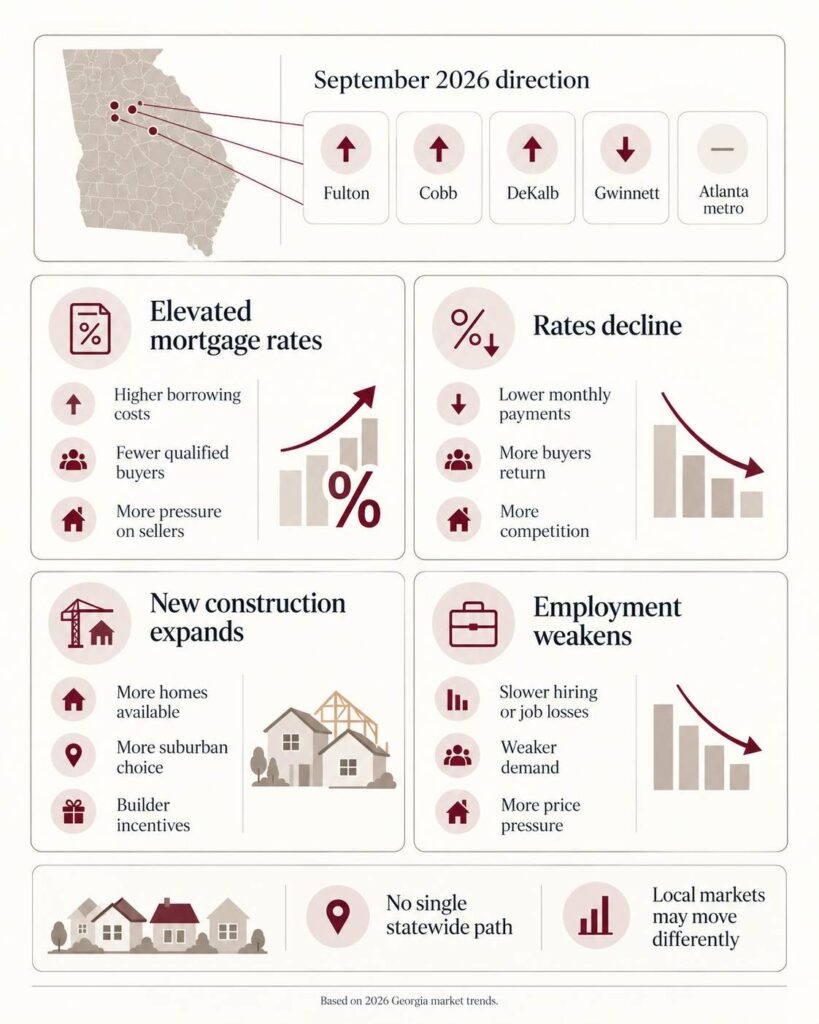
Georgia enters the final months of 2026 with more homes available and weaker transaction volumes across several major counties. However, the figures do not point to a uniform collapse in prices.
In September, the median sale price was down slightly in Gwinnett County but higher in Fulton, Cobb and DeKalb. The Atlanta metropolitan median was almost unchanged from one year earlier.
- Mortgage rates remain elevated. Higher financing costs could continue to limit the number of qualified buyers and increase pressure on sellers.
- Rates decline. Lower monthly payments could bring additional buyers into the market, increasing competition for desirable properties.
- New construction expands. Additional homes could provide more choices in developing suburban areas, particularly where builders are willing to offer incentives.
- Employment conditions weaken. Slower hiring or job losses could reduce demand, especially in communities dependent on a small number of major employers.
Georgia also competes with other Sun Belt destinations for residents and businesses. People considering relocation may compare Atlanta with Charlotte, Raleigh, Nashville and major Texas cities.
If you are interested in regional migration trends, our article about Americans relocating to North Carolina explores housing costs, employment and other reasons households consider moving.
Future housing prices will also depend on how much new construction reaches the market, how local employers perform and how mortgage financing develops. A statewide forecast cannot reliably predict the price of an individual house in Norcross, Marietta or Savannah.
So, Is 2026 a Good Time to Buy a House in Georgia?
For buyers who can comfortably afford current mortgage rates, Georgia offers more negotiating opportunities than during the intense competition of the early 2020s. Sellers are facing longer listing periods in many areas, and several counties have recorded notable declines in transaction volumes.
A buyer planning to stay for seven or ten years has more room to focus on finding the right property rather than guessing where prices will move next month. Someone stretching their budget to afford a house, however, could face serious financial pressure from insurance, property taxes or unexpected repairs.
The clearest advantage in 2026 is the extra time buyers have to investigate a property before committing. Compare recent sales, obtain financing quotes, inspect the house thoroughly and negotiate the repairs or closing costs that will affect your total purchase expense.
If a house in the right neighborhood fits your budget at today’s interest rate, waiting for a cheaper mortgage is not necessarily the better choice. If the payment only becomes affordable after rates fall, renting for another year may be the safer financial decision.