


Stay with us and find out where the next one takes us.
- Seattle Housing Market 2026, Is Now a Better Time to Buy a House? - October 21, 2026
- US States Ranked by Work-Life Balance, Where Are People Happiest? - October 20, 2026
- More Than 30% of Homes in California Now Sell for Over $1 Million - October 20, 2026
Home prices in Seattle have fallen, sales have slowed, and buyers have more properties to compare. Yet the city remains an expensive place to purchase a house, with the median sale price still above $850,000.
For sellers, the challenge is no longer simply getting a property listed. Pricing it correctly, presenting it well, and dealing with problems before buyers discover them can influence how quickly a sale moves forward.
Home Prices Fall as Sales Slow Down
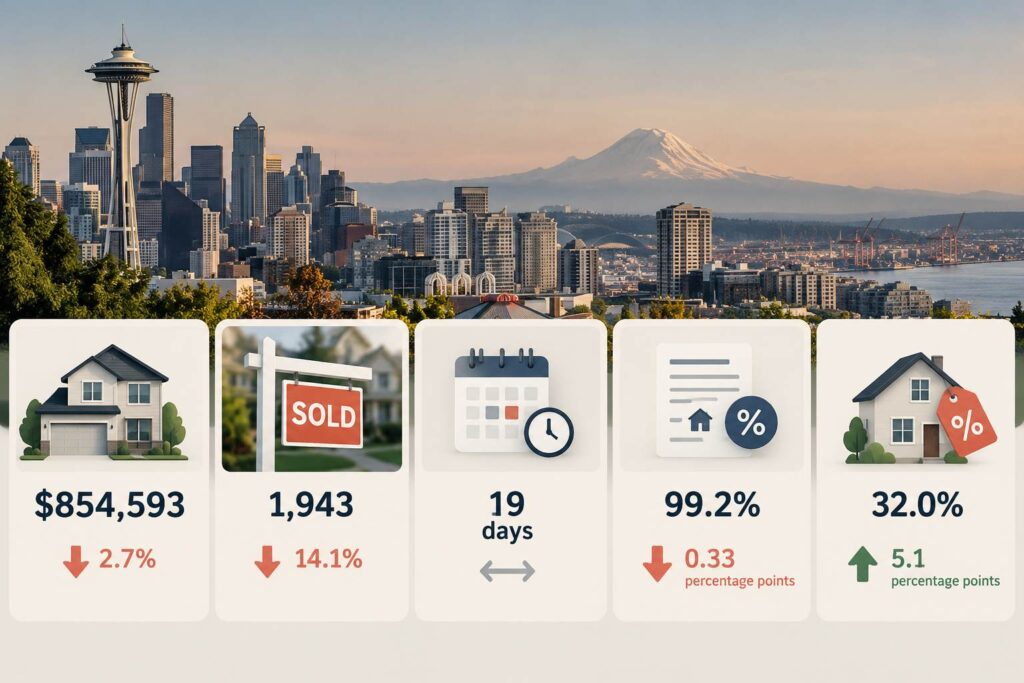
Seattle’s median home sale price reached $854,593 in September 2026, down 2.7% from the same period in 2025, according to Redfin’s Seattle housing data.
The number of completed home sales also declined. September recorded 1,943 sales, compared with 2,263 a year earlier, representing a 14.1% decrease.
Buyers are not necessarily abandoning Seattle. They are purchasing fewer homes, and more sellers are adjusting their expectations.
| Seattle Housing Market Indicator | September 2026 | Annual Change |
| Median home sale price | $854,593 | Down 2.7% |
| Homes sold | 1,943 | Down 14.1% |
| Median days on market | 19 days | Unchanged |
| Sale-to-list price ratio | 99.2% | Down 0.33 percentage points |
| Listings with price reductions | 32.0% | Up 5.1 percentage points |
Source: Redfin, September 2026. Figures cover all residential property types within Seattle city limits.
One number deserves particular attention from homeowners preparing to sell. Nearly one-third of active listings had experienced a price reduction.
That does not mean every seller must lower their asking price. It does suggest that setting an ambitious price and waiting for buyers to accept it has become riskier.
Redfin also found that Seattle homes sold for an average of 0.8% below their asking prices. On an $850,000 listing, that percentage represents $6,800.
More Homes Are Available Across the Seattle Region
Seattle’s slowdown is part of a wider shift across Washington.
The Northwest Multiple Listing Service reported 24,965 active listings across its 27-county service area at the end of September 2026, an increase of 24.5% from the previous year.
Pending sales fell 15.1% to 6,231, and completed transactions declined 8.9% to 5,623.
The number of homes available for sale reached its highest September level since 2014. Buyers had more properties to inspect, but fewer were moving forward with purchases.
King County, which includes Seattle, recorded a 31.1% increase in active inventory. Its median sale price across houses and condominiums remained at $850,000, unchanged from September 2025.
For single-family homes alone, the county median was $949,975.
Those county figures should not be confused with Seattle city statistics. They cover a much larger area, including Bellevue, Redmond, Renton, and other communities.
For someone selling a home, additional inventory means greater competition from similar properties. Buyers may be able to compare several houses in the same price range instead of making a decision after visiting only one or two.

Are Seattle Home Prices Falling Everywhere?
Not every Seattle neighborhood has experienced the same changes.
In Central Seattle, Redfin recorded a median sale price of $974,702 during the three months ending September 2026, a decline of 7.2% from the same period a year earlier.
The Central Area recorded a median of $843,764, down 18.5%. Madison Park remained substantially more expensive, with a median price of $1,961,950 despite a 12.4% annual decline.
These neighborhood figures illustrate why citywide averages cannot tell a homeowner what their particular property is worth.
They also require careful interpretation. A neighborhood’s median can change because expensive or inexpensive properties account for a larger share of sales, even if individual home values move less dramatically.
A three-bedroom house near a popular school, for example, competes with a different set of properties than a small condominium in a nearby commercial district.
Before listing a home, sellers should examine recent completed sales involving comparable properties. Current asking prices show what other owners hope to receive, not necessarily what buyers have agreed to pay.
Why Are Buyers More Cautious in Seattle?

Higher borrowing costs remain one obstacle. Even a relatively small change in mortgage rates can alter the monthly payment on an expensive Seattle property.
Consider an $850,000 home purchased with a 20% down payment. The buyer would borrow $680,000.
At a 6% fixed interest rate over 30 years, principal and interest would total $4,077 per month. At 7%, the same loan would require $4,524 per month.
That is an additional $447 every month, before property taxes, insurance, and maintenance.
Buyers also have to consider employment stability and the amount of savings left after purchasing a property. A household may qualify for a mortgage but hesitate to commit much of its income to a single expense.
Meanwhile, sellers who purchased or refinanced when mortgage rates were much lower may be reluctant to accept a reduced sale price.
The result can be a market with more homes available but fewer completed purchases.
What Should You Do Before Listing Your Property?
A slower market does not mean every seller needs to renovate the house. Expensive improvements can consume money without producing an equivalent increase in the final sale price.
The priority should be addressing problems buyers can identify during a viewing or inspection, then presenting the property at a price supported by recent local sales.
Set the Asking Price Using Recent Sales
Start with homes of similar size, age, condition, and location that have sold recently.
If three comparable properties sold for $790,000, $815,000, and $825,000, listing a similar home at $950,000 needs a convincing explanation.
Substantial renovations, a larger lot, or a superior location might justify a premium. An owner’s emotional attachment to the property does not establish its market value.
Pay attention to the number of days competing listings have remained unsold and any reductions in their asking prices.
Handle Visible Maintenance Problems Before Showings

A dripping faucet, damaged gutter, slow-draining sink, or stained ceiling can distract buyers from the rest of the house.
Some problems also raise questions about hidden damage. A minor leak near a window may cause a visitor to wonder if water has entered the wall. A persistent drainage problem may lead to concerns about the plumbing system.
Seattle’s rainy climate makes signs of moisture especially relevant. Homeowners should check gutters, downspouts, exterior drainage, and areas around windows and doors.
Slow drains, recurring backups, or sewage odors deserve professional attention rather than a cosmetic cover-up.
Sellers dealing with these problems can arrange Drain Cleaning in Seattle before putting the property on the market, particularly when ordinary cleaning has not resolved the blockage.
Keep receipts for completed repairs and disclose known defects as required by Washington law. Repair documentation can help answer questions when a buyer requests information about the property’s condition.
Make Small Improvements That Buyers Will Notice
Fresh paint in damaged areas, clean windows, functioning light fixtures, and repaired cabinet hardware can improve the presentation of a property without requiring major construction.
Small fixes such as sealing gaps around windows and doors can also improve comfort, particularly when soundproofing repairs help reduce unwanted outdoor noise.
Outdoor areas deserve attention too. Clear walkways, trimmed vegetation, and properly maintained steps make it easier for visitors to inspect the exterior.
For older homes, focus on repairs that improve function and safety. A beautiful photograph will not compensate for an obvious roof leak or a bathroom fixture that does not work.
Prepare the Home for Listing Photographs

Many buyers first encounter a property through photographs rather than an in-person visit.
Clear countertops, remove unnecessary belongings, clean reflective surfaces, and make sure rooms are well lit.
Photographs should represent the actual house accurately. Wide-angle images can help show the layout, but misleading room proportions may disappoint buyers when they arrive.
A floor plan can also help visitors understand how rooms connect, particularly in older Seattle homes with unusual layouts or additions.
Review the Inspection and Disclosure Requirements
Washington sellers may be required to provide a seller disclosure statement under the state’s residential real property disclosure law, subject to statutory exceptions.
The disclosure addresses known conditions involving the property, including structural systems, utilities, environmental issues, and other matters specified by law.
Sellers should review the requirements in Washington Revised Code Chapter 64.06 rather than assuming that a fresh coat of paint or completed repair removes the need to answer questions about past problems.
When a significant defect is discovered, a qualified inspector or contractor can help establish the nature of the problem and the work needed to resolve it.
Should You Renovate Before Selling a Seattle Home?

A complete kitchen renovation may look attractive in listing photographs, but spending $50,000 on the project does not guarantee that the final sale price will increase by $50,000.
The decision depends on the condition of the existing kitchen and the expectations of buyers shopping in that neighborhood.
A clean, functional kitchen with slightly older cabinets may not justify replacement. On the other hand, damaged countertops, unsafe electrical work, or leaking plumbing can affect a buyer’s assessment of the property.
Sellers should separate necessary repairs from improvements intended mainly to change the appearance of a room.
Before approving major work, compare the estimated renovation expense with recent sale prices of similar renovated and unrenovated homes. A local agent can help identify which features buyers are currently paying more to obtain.
How Long Does It Take to Sell a House in Seattle in 2026?
Redfin reported a median of 19 days on the market for Seattle homes in September 2026, unchanged from a year earlier.
That measure does not mean every home sells within three weeks. Some receive offers quickly, and others remain listed for considerably longer.
Condition, location, asking price, property type, and the number of competing listings influence the time required to find a buyer.
Even after an offer is accepted, a financed purchase can require additional time for the mortgage process, appraisal, title work, inspections, and closing arrangements.
Sellers planning to move on a fixed date should leave room for unexpected delays rather than scheduling everything around the median marketing period.
The Bottom Line
The latest statistics point to a more demanding market for sellers, but they do not establish that every homeowner should delay selling.
Seattle’s median home price remains high by national standards. Well-maintained properties with realistic asking prices are still finding buyers, and some attract multiple offers.
However, the combination of falling citywide prices, fewer completed sales, and more listings means sellers have less room to rely on the market alone.
Someone who needs to relocate for employment may benefit from selling now rather than waiting for an uncertain change in prices. Another homeowner with no immediate reason to move may prefer to examine rental options, renovation plans, or future market conditions before making a decision.
For owners proceeding with a sale, the September data provide a clear starting point. Homes are selling, but buyers have more choices and are more willing to negotiate. Accurate pricing, documented repairs, and a property that is ready for inspection can help a listing compete without unnecessary spending.