


Stay with us and find out where the next one takes us.
- US States Ranked by Work-Life Balance, Where Are People Happiest? - October 20, 2026
- More Than 30% of Homes in California Now Sell for Over $1 Million - October 20, 2026
- How Much Does It Cost to Make a Music Video? - October 19, 2026
Utah has the best work environment in America, Hawaii has the happiest residents, and California leads a separate national ranking for employee rights. The three results tell very different stories about what makes life outside work enjoyable.
Living in a state with shorter working hours can free up more time for family and hobbies. Higher salaries help pay the bills, but expensive housing can consume much of the extra income. Even a rewarding career becomes exhausting when long commutes and unpredictable schedules leave little room for anything else.
Research published in September 2026 offers a state-by-state comparison of employment conditions and overall happiness. The results contain several surprises, including the low work environment rankings of California and New York.
Here Is the List
Utah ranks first, followed by South Dakota and Idaho, according to the work environment category of WalletHub’s 2026 Happiest States study, published September 8.
The ranking considers working hours, commuting, unemployment, financial anxiety, job security and several other employment-related measures. It is not a direct survey asking residents to rate their work-life balance.
| Work Environment | State | Overall Happiness |
| 1 | Utah | 3 |
| 2 | South Dakota | 24 |
| 3 | Idaho | 4 |
| 4 | North Dakota | 12 |
| 5 | Hawaii | 1 |
| 6 | Nebraska | 6 |
| 7 | Montana | 30 |
| 8 | New Hampshire | 10 |
| 9 | Vermont | 22 |
| 10 | Maine | 34 |
| 11 | Minnesota | 8 |
| 12 | Kansas | 23 |
| 13 | South Carolina | 15 |
| 14 | Tennessee | 41 |
| 15 | Missouri | 31 |
| 16 | Iowa | 20 |
| 17 | Massachusetts | 13 |
| 18 | Wisconsin | 27 |
| 19 | Indiana | 33 |
| 20 | Maryland | 5 |
| 21 | North Carolina | 14 |
| 22 | Georgia | 18 |
| 23 | Colorado | 36 |
| 24 | New Jersey | 2 |
| 25 | Washington | 19 |
| 26 | Rhode Island | 29 |
| 27 | Connecticut | 7 |
| 28 | Delaware | 28 |
| 29 | Florida | 21 |
| 30 | Texas | 35 |
| 31 | Virginia | 16 |
| 32 | Ohio | 39 |
| 33 | Arizona | 17 |
| 34 | New York | 11 |
| 35 | Alabama | 45 |
| 36 | California | 9 |
| 37 | Pennsylvania | 25 |
| 38 | Oregon | 42 |
| 39 | Nevada | 32 |
| 40 | Illinois | 26 |
| 41 | Kentucky | 46 |
| 42 | Wyoming | 43 |
| 43 | Oklahoma | 40 |
| 44 | Alaska | 47 |
| 45 | Michigan | 38 |
| 46 | Mississippi | 37 |
| 47 | Arkansas | 48 |
| 48 | New Mexico | 44 |
| 49 | Louisiana | 49 |
| 50 | West Virginia | 50 |
Utah and Idaho perform well in both categories, but South Dakota ranks second for work environment and only 24th for overall happiness. California has almost the reverse result, placing ninth for happiness despite finishing 36th for work environment.
Why is Utah First?

Residents of Utah work fewer hours per week on average than people in any other state measured by WalletHub. The state also finishes first for community and environment, a category that considers leisure time, volunteer participation, safety and other local conditions.
Utah has a relatively low unemployment rate and performs particularly well for economic security. Its major employment centers include Salt Lake City, Provo and Ogden, with jobs across technology, healthcare, financial services and manufacturing.
There is also a large outdoor recreation industry. Hiking trails, ski resorts and national parks attract visitors, while residents have access to activities outside the workplace throughout the year.
Housing costs remain an obstacle in popular communities. Shorter average working hours do not guarantee that someone earning a modest salary can afford a house close to their job.
Hawaii Is the Happiest State, Despite Its High Living Costs
Hawaii ranks first for overall happiness and fifth for work environment. It also finishes second for emotional and physical well-being.
Residents have access to beaches, outdoor recreation and a climate that allows many activities throughout the year. However, Hawaii also has some of the most expensive housing in the country, and everyday goods can be costly because of transportation and distribution expenses.
Leisure activities also contribute to emotional well-being, with research highlighting the benefits of music on our mind, culture, and relationships.
Employment presents another complication. Tourism, hotels, restaurants and healthcare support substantial numbers of jobs, but many positions involve evening or weekend shifts.
Hawaii performs well across several measures of personal well-being. Its first-place happiness result should not be interpreted as evidence that every employee has an easy schedule or substantial disposable income.

South Dakota and Idaho Offer Two Very Different Results
South Dakota reaches second place for work environment, helped by its employment and economic measures. However, the state drops to 24th for overall happiness.
Idaho ranks third for work environment and fourth for happiness. It also recorded the highest income growth among the states measured in the study.
Population growth and housing demand have changed several Idaho communities, particularly around Boise. Employees considering relocation need to compare current wages with local rent and house prices, rather than assuming that lower costs from several years ago still apply.
South Dakota presents another set of considerations. Sioux Falls has a substantial healthcare and financial services employment base, although professional opportunities and lifestyle choices can be more limited in smaller communities.
Why California and New York Perform Poorly on Work Environment?
California ranks ninth for happiness but only 36th for work environment. New York is 11th for happiness and 34th for work environment.
Both states have major concentrations of high-paying professional jobs. California is home to Silicon Valley and Hollywood, while New York City supports large financial, media and technology industries.
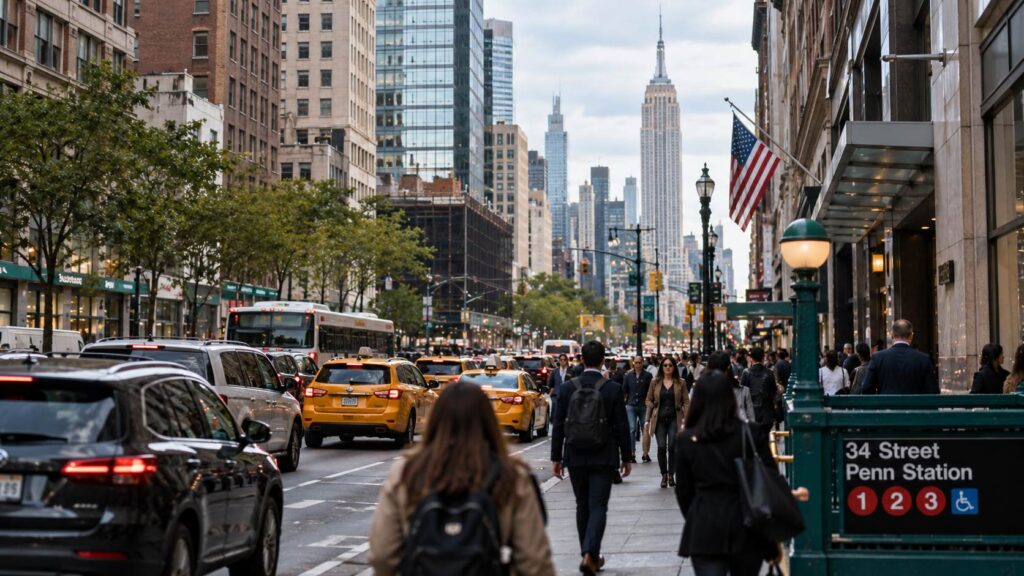
Living close to those employment centers can be prohibitively expensive. Workers who move farther away to reduce housing expenses may spend more time commuting, adding unpaid hours to their daily schedules.
California is among the states with the shortest mean working hours in the WalletHub study, yet it also has the highest long-term unemployment rate in the dataset. Employment conditions depend on more than the length of the working week.
Long commutes affect how people spend their personal time, although small changes, such as creating a playlist for the daily commute, can make the journey more enjoyable.
How State Labor Laws Affect Work-Life Balance
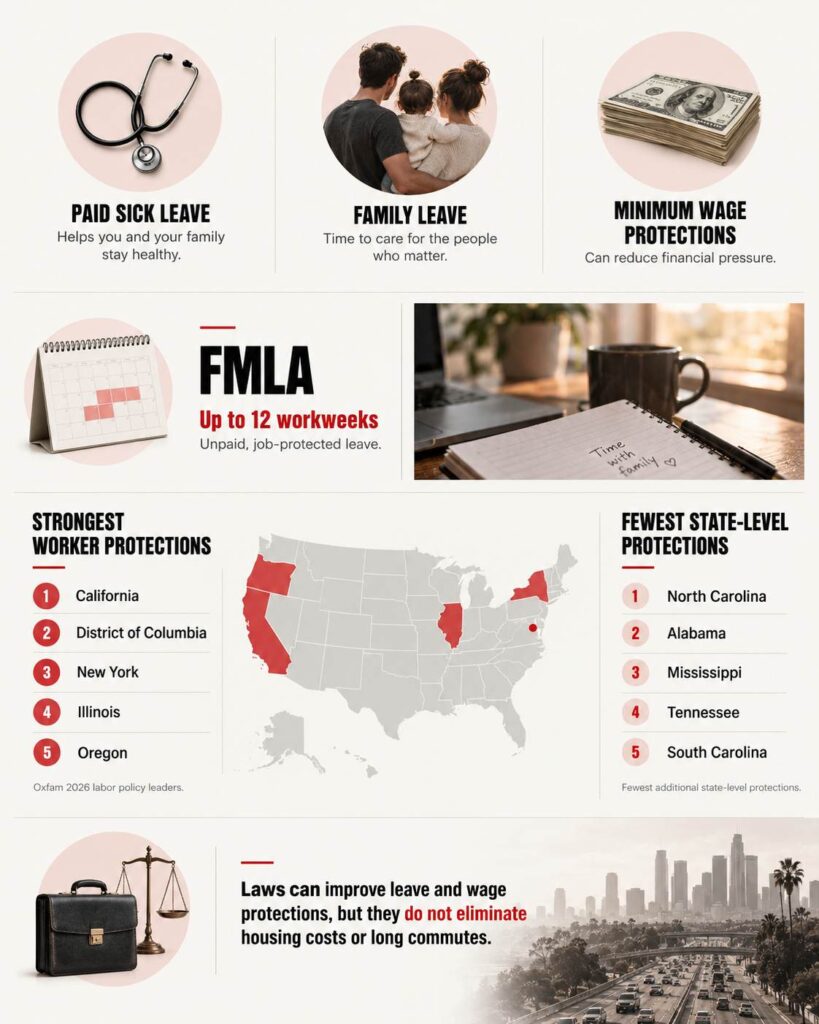
Paid sick leave, family leave and minimum wage protections can reduce financial pressure when employees become ill or need time away from work.
State laws determine many of these benefits, creating substantial gaps between workers doing similar jobs in separate parts of the country.
The federal Family and Medical Leave Act gives eligible employees of covered employers up to 12 workweeks of unpaid, job-protected leave for specified medical and family reasons.
The Department of Labor’s FMLA guidance also explains employer coverage and employee eligibility.
Several states go further by establishing paid family or medical leave programs. Workers who qualify can receive partial wage replacement during covered absences.
California and New York Lead on Worker Protections
The 2026 Oxfam Best States to Work Index ranks California first for labor policies, followed by the District of Columbia, New York, Illinois and Oregon.
Its scoring considers wages, worker protections and collective bargaining rights. California has established paid sick leave and paid family leave programs, along with additional protections for certain occupations.
The ranking measures the laws in place, not how satisfied individual employees feel at work. An employee can have extensive legal rights and still struggle with housing costs or an exhausting commute.
Where Workers Have Fewer State-Level Protections
North Carolina places last in the Oxfam index, followed by Alabama, Mississippi, Tennessee and South Carolina. The five states provide fewer additional protections than the leading states across several measures used in the research.
Employers can voluntarily offer higher wages and more generous leave than their state requires. Still, employees without those benefits have fewer state-level guarantees.
Nevada, which ranks 39th for work environment, has separate workers’ compensation laws covering qualifying job-related injuries, including rules on claims and appeals under state workers’ compensation guidance.
If you have suffered an injury in Nevada and believe someone else was responsible, our advice is to contact a Personal Injury Attorney in Nevada to discuss your legal rights and possible compensation.
Americans Work More Than Eight Hours on a Typical Full-Time Working Day
Full-time employees in the United States worked an average of 8.1 hours on days when they worked in 2025, according to the American Time Use Survey released by the Bureau of Labor Statistics in June 2026.
The average reached 8.5 hours on weekdays and 5.5 hours on weekend working days. Nearly 30% of full-time employees worked on an average weekend day.
Working hours also vary substantially between states. Utah recorded the fewest mean working hours in the WalletHub research, followed by Vermont and Rhode Island. Alaska had the longest average working hours, with Louisiana, Texas and Mississippi also near the bottom.
The national figures do not include commuting in paid working hours. Someone spending nine hours at work and another 90 minutes traveling each day has substantially less free time than an employee with a shorter commute.
New Jersey Ranks Second for Happiness Despite Its Employment Ranking
View this post on Instagram
New Jersey finishes second nationally for overall happiness, although its work environment ranks 24th.
The state records the lowest adult depression rate in the study and ranks first for emotional and physical well-being. It also has the second-highest share of households earning more than $75,000 annually.
Those incomes support residents living near major employment centers in New York City and Philadelphia, although expensive housing and commuting costs remain important considerations.
New Jersey also has a low separation and divorce rate. Its community and environment results are less impressive than its emotional well-being score, which helps explain why the state does not lead every category.
States Where Work Conditions and Happiness Are Both Low
West Virginia ranks last in both work environment and overall happiness. Louisiana finishes 49th in each category.
Arkansas, New Mexico and Mississippi also appear near the bottom of the employment ranking, although their overall happiness positions vary.
Long-term unemployment, financial insecurity and limited local employment opportunities can influence how residents experience their working lives. Lower housing prices alone do not guarantee financial comfort when wages are also low.
Alaska presents a separate challenge. It ranks 44th for work environment, 47th for happiness and last for mean working hours. Some industries, including oil extraction, fishing and seasonal tourism, involve demanding schedules that can keep employees away from home for extended periods.
Does Working From Home Improve Work-Life Balance?
View this post on Instagram
Remote work eliminates the daily commute for employees who can perform their jobs from home. Someone previously spending an hour traveling each way can recover ten hours during a five-day working week.
The American Time Use Survey found that 35% of employed people did some or all of their work at home on days when they worked in 2025. Another 70% did some or all of their work at a workplace, with the categories overlapping because some people worked in both locations.
Remote work does not automatically produce shorter hours. Employees may remain available outside their scheduled shifts, and households with limited space can find it difficult to separate professional responsibilities from personal life.
Setting boundaries between work and home also matters for maintaining shared values in modern relationships, particularly when couples spend much of their day working in the same space.
Job flexibility is also concentrated in certain occupations. Software development, financial analysis and administrative positions offer more opportunities for remote arrangements than restaurant service, construction or emergency medical work.
Final Thoughts
Utah leads the 2026 work environment ranking, followed by South Dakota and Idaho. Hawaii takes first place for overall happiness, with New Jersey second.
The results also reveal that impressive salaries and extensive employee protections do not guarantee a comfortable daily schedule. California and New York perform well for overall happiness but rank much lower for their work environments.
If you are considering relocating for work, compare the actual salary, expected weekly hours and housing expenses in the city where you intend to live. A state ranking can identify promising destinations, but the conditions attached to your next job will determine how much time and money you have outside work.