
Stay with us and find out where the next one takes us.
- US States Ranked by Work-Life Balance, Where Are People Happiest? - October 20, 2026
- More Than 30% of Homes in California Now Sell for Over $1 Million - October 20, 2026
- How Much Does It Cost to Make a Music Video? - October 19, 2026
In California, a million dollars no longer guarantees a mansion, a swimming pool or even a large backyard. In some neighborhoods, it barely gets you an ordinary three-bedroom house.
During September 2026, 35.9% of existing single-family homes sold in California went for more than $1 million.
Los Angeles, San Francisco and coastal Orange County still have some of the highest property prices in the country.
Yet million-dollar homes are hardly confined to streets lined with celebrity estates. Families searching for houses near major employment centers are paying similar amounts for properties that would be considerably cheaper in most other states.
California remains home to Hollywood, Silicon Valley and some of the most desirable coastal communities in America. Its housing market also has a serious affordability problem, with fewer people able to purchase a typical home on local wages.
More Than One in Three California Homes Sold for Over $1 Million
The share of million-dollar home sales reached 35.9% in September 2026, up from 35.2% in August, according to the California Association of Realtors September housing report.
The statewide median sale price reached $899,720, an increase of 1.7% from September 2025. Home sales, meanwhile, declined by 6.5% compared with the same month last year.
| California Housing Market | September 2026 |
| Homes selling above $1 million | 35.9% |
| Median single-family home price | $899,720 |
| Annual median price increase | 1.7% |
| Annual change in home sales | -6.5% |
| Annualized home sales | 260,410 |
| Median time on market | 29 days |
| Homes selling below or above asking price, combined ratio | 98.8% of asking price |
View this post on Instagram
The 260,410 sales figure is a seasonally adjusted annualized rate, not the number of houses sold during September alone. The report covers existing single-family houses, so the 35.9% figure should not be applied to every condominium or newly constructed property.
The median price is still below $1 million statewide because homes in the Central Valley, Inland Empire and northern counties sell for substantially less than properties in the most expensive coastal regions.
California recorded annual price increases in 33 of the 53 counties tracked by the association. Another 17 counties experienced declines, and three remained unchanged.
How Expensive Are Homes Across California in 2026?
A $900,000 budget can buy very different properties depending on the location. In San Francisco, it may not be enough for a typical detached house. In parts of the Central Valley, the same amount could cover a much larger property with money remaining for improvements.
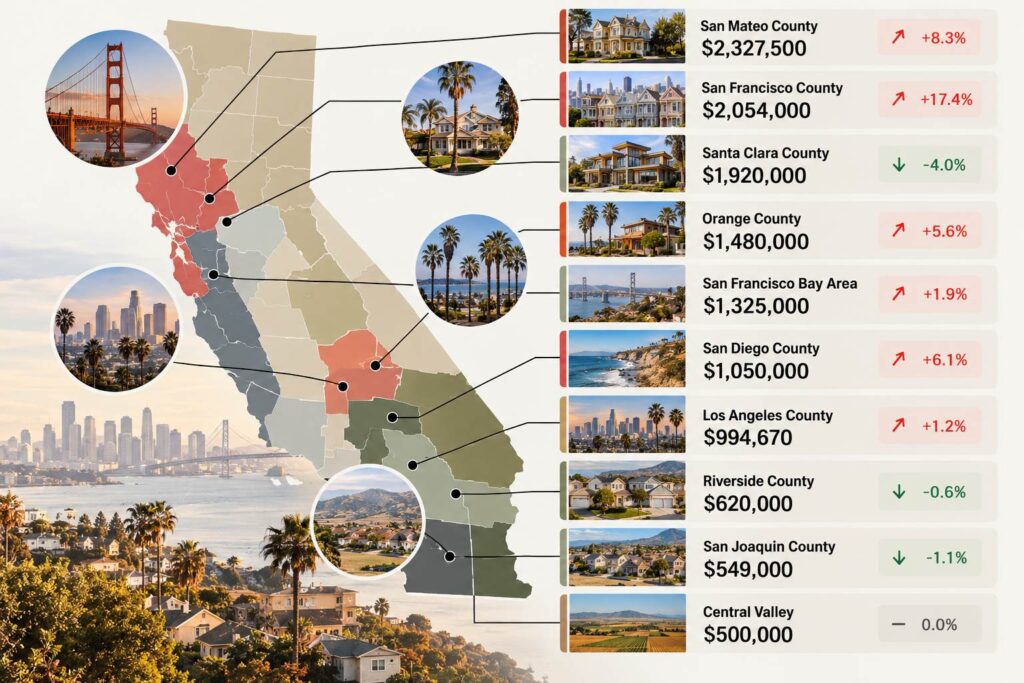
September 2026 median sale prices demonstrate how widely housing costs vary across the state.
| California Region or County | Median Home Price | Annual Price Change |
| San Mateo County | $2,327,500 | +8.3% |
| San Francisco County | $2,054,000 | +17.4% |
| Santa Clara County | $1,920,000 | -4.0% |
| Orange County | $1,480,000 | +5.6% |
| San Francisco Bay Area | $1,325,000 | +1.9% |
| San Diego County | $1,050,000 | +6.1% |
| Los Angeles County | $994,670 | +1.2% |
| Riverside County | $620,000 | -0.6% |
| San Joaquin County | $549,000 | -1.1% |
| Central Valley | $500,000 | 0.0% |
All figures refer to existing single-family homes sold during September 2026. A median represents the middle transaction price, so a change in the types of homes sold can influence the figure without every individual property gaining or losing value.
San Francisco and Silicon Valley
San Mateo County recorded a median price above $2.3 million in September. Santa Clara County, which includes San Jose and much of Silicon Valley, reached $1.92 million.
Technology employment, high household incomes and limited space for additional housing contribute to the enormous prices in these communities.
In San Francisco itself, the median detached home sold for $2.054 million. A buyer spending $1 million would be looking well below the county median.
Los Angeles and Orange County
Los Angeles County recorded a median price of $994,670, placing the typical detached home close to the million-dollar threshold.
Orange County was even more expensive at $1.48 million. Coastal communities, employment centers and high-income neighborhoods help sustain demand, despite the substantial cost of purchasing a home.
Within Los Angeles, prices vary considerably between neighborhoods. A property in Beverly Hills or Bel Air operates in a separate luxury market from a modest house in the San Fernando Valley.
The Central Valley Offers Lower Purchase Prices
California still has communities where $1 million buys far more than an ordinary family house.
The Central Valley recorded a median sale price of $500,000 in September, with San Joaquin County at $549,000.
Communities such as Stockton, Manteca and Tracy attract households looking for lower housing costs than those found around the San Francisco Bay Area. However, commuting distances, local employment and transportation expenses influence how much a household actually saves.
Our article on why Americans are moving to Texas explores another response to expensive housing, with some households relocating to states where their income can support a larger home.
What Is Making California Homes So Expensive?
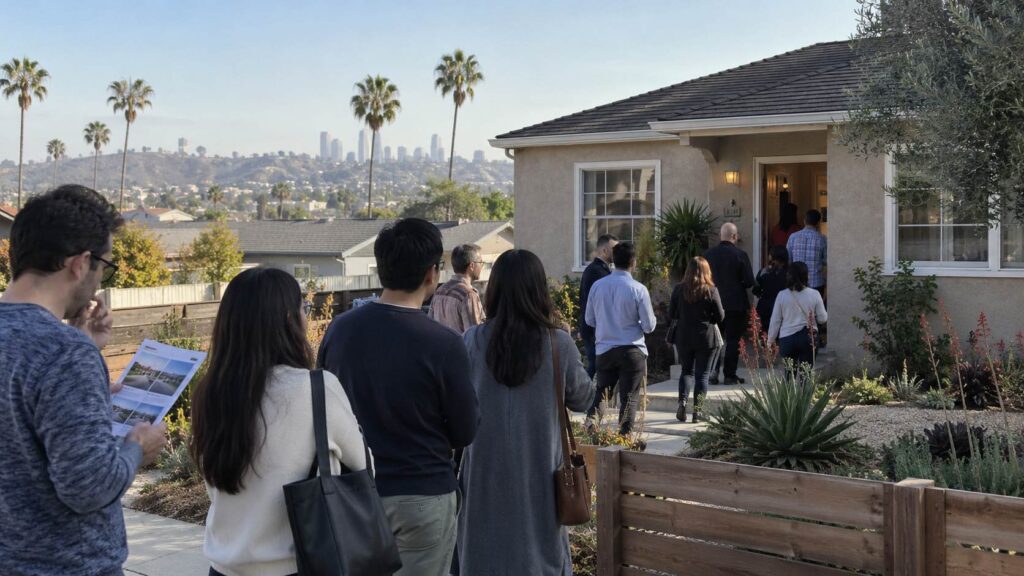
California has spent decades adding housing more slowly than demand has grown in several of its major employment centers.
Coastal geography limits expansion in some communities, and local zoning restrictions can make it difficult to construct apartments or higher-density residential developments.
Building new housing also involves land acquisition, labor costs, construction materials and local approval processes. Those expenses influence the prices developers need to charge.
High-Paying Jobs Keep Demand Concentrated
California has major employment centers in technology, entertainment, biotechnology, healthcare and professional services.
Households earning substantial incomes can compete aggressively for homes near those employers. The resulting prices make ownership harder for workers earning ordinary local wages.
Silicon Valley provides a clear example. High incomes in technology can support purchases that would be unaffordable to many teachers, service workers and other residents of the same communities.
Existing Owners Have Little Incentive to Sell
Homeowners who secured mortgage rates near 3% several years ago face a substantial financial disadvantage if they sell and purchase another property at current rates.
Some consequently remain in homes that no longer suit their needs, reducing the number of properties available to potential buyers.
California also has property tax rules that can make long-term ownership financially attractive. Under Proposition 13, the assessed value of a property generally cannot increase by more than 2% annually unless an event such as a change in ownership or qualifying new construction triggers reassessment.
Longtime homeowners may therefore face much lower taxable assessed values than people purchasing similar properties today.
California Home Selling Prices in 2026 and What Sellers Should Expect
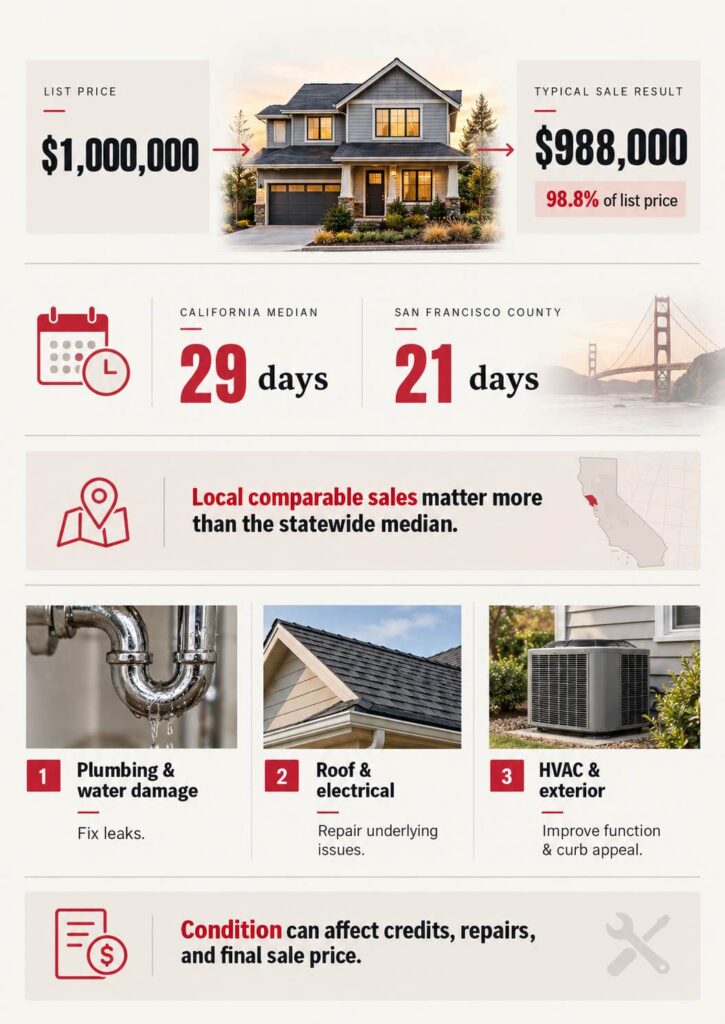
A California house listed for $1 million will not necessarily sell for $1 million. Its final price depends on comparable transactions, local competition and the condition of the property.
The statewide sale-to-list-price ratio was 98.8% in September 2026. Applied to a hypothetical $1 million listing, that ratio produces a selling price of $988,000, although individual transactions can finish far above or below asking.
Across the state, the median time needed to sell a single-family home was 29 days. San Francisco County had a median of 21 days, while properties in some less active markets remained listed considerably longer.
If you are planning to sell, recent completed transactions in your neighborhood provide a more useful basis for pricing than the statewide median. The physical condition of your home also affects the repairs and credits a buyer may request.
Repairs That Can Influence the Final Sale Price
An expensive kitchen renovation does not guarantee an equally large increase in sale value. Resolving known defects may be more valuable when the alternative is a difficult inspection or a buyer withdrawing an offer.
Plumbing and Water Damage
Leaking pipes, recurring drain backups and water stains can lead to repair negotiations, particularly when buyers suspect damage behind walls or beneath flooring.
If you discover a plumbing problem shortly before putting your house on the market, arrange for a local professional to inspect and repair it.
For example, homeowners in Manteca can contact Plumbers in Manteca, CA.
Roofing and Electrical Systems
Roof leaks, damaged flashing and outdated electrical components can become expensive inspection findings. Repairs should address the underlying defect rather than conceal visible symptoms.
Heating, Cooling and Exterior Condition
A poorly functioning HVAC system can create an additional expense for the buyer, while damaged siding and neglected landscaping affect the appearance of the property.
Routine air conditioner maintenance can help identify problems with filters and coils before the equipment fails.
Several essential home maintenance checks are relevant before selling as well, especially those involving water, electricity and safety equipment.
How Much Income Do You Need to Buy a $1 Million Home?
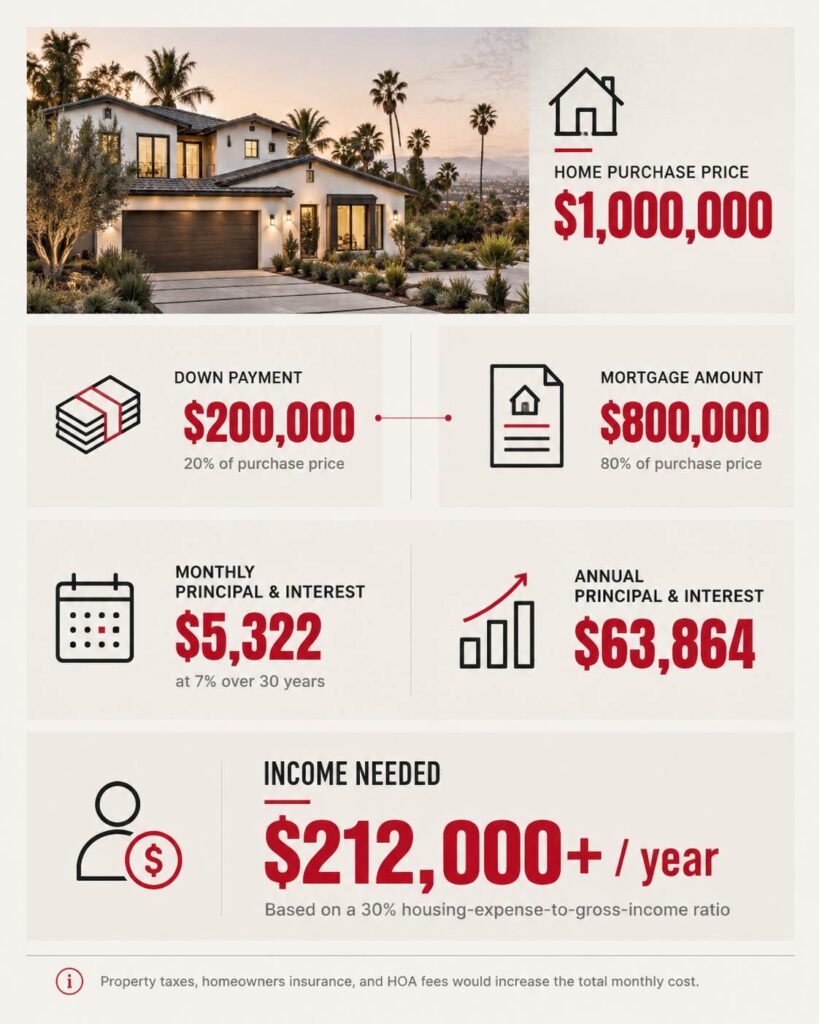
A million-dollar purchase requires substantial income even when the buyer has saved a large down payment.
Consider a household buying a $1 million property with $200,000 down. The remaining mortgage would be $800,000.
Using a hypothetical 7% fixed interest rate over 30 years, the monthly principal and interest payment would be $5,322. Property taxes, homeowners insurance and any HOA fees would increase that amount.
| Purchase Expense | Illustrative Amount |
| Home purchase price | $1,000,000 |
| Down payment at 20% | $200,000 |
| Mortgage amount | $800,000 |
| Monthly principal and interest at 7% | $5,322 |
| Annual principal and interest | $63,864 |
At an illustrative 30% housing-expense-to-gross-income ratio, principal and interest alone would require annual household income exceeding $212,000. The income needed would be higher after including taxes and insurance, and actual mortgage qualification depends on debts, credit history, assets and loan rules.
Even households earning six figures can struggle to afford detached homes in California’s most expensive counties.
Hollywood, Celebrities and Most Expensive Neighborhoods
Hollywood has helped turn several Los Angeles neighborhoods into internationally recognizable addresses. Beverly Hills, Bel Air, Malibu and Hidden Hills have become associated with actors, musicians and entertainment executives who can afford multimillion-dollar estates.
Celebrity ownership can increase the visibility and prestige of a neighborhood, although it would be misleading to blame California’s statewide housing prices on famous residents. Limited land, high local incomes, privacy and desirable locations are major reasons these properties command enormous prices.
Beverly Hills and Bel Air
For decades, Beverly Hills and Bel Air have attracted movie stars and entertainment executives looking for luxury homes near Hollywood.
Large estates can sell for tens of millions of dollars, with buyers paying for privacy, architecture and substantial land in addition to the house itself.
Recent development has pushed the luxury market further. The One Beverly Hills development includes residences starting at $15 million, with a penthouse reservation reportedly valued at $200 million.
Properties at those prices represent an entirely separate market from the average California home.
Hidden Hills and the Kardashian Family
@tyler_therealtor Hidden Hills was once a sleepy horse town on the edge of the San Fernando Valley. Then the Kardashians moved in. 🐎🏡 Founded in 1949, Hidden Hills was designed as a rural escape from LA, with acre-plus lots, white rail fences, bridle trails instead of sidewalks, and four-bedroom homes selling for under $50,000. Then in 2010, Kris Jenner bought a $4 million Mediterranean mansion that became one of the most recognizable homes on Keeping Up with the Kardashians. Kim and Kanye, Kylie and Khloé followed, helping turn the tiny gated city into “Kardashian Country” and attracting celebrities from Drake to Madonna. Now Kris has listed that original mansion for $13.5 million. Would you live in Hidden Hills? Let me know in the comments👇 For more on this listing, click my link in bio 🏡🔗 📍25115 Eldorado Meadow Rd, Hidden Hills, CA 91302 💰$13,500,000 🏡6 bed, 8 bath, 8,860 sqft 📐1.55 acres 📲Call (323)578-4949 for a private showing 🕴Listed by Tomer Fridman | Luxury Real Estate Christie’s Int’l Real Estate Buying or selling anywhere else in LA? Gimme a call 👉 (323) 578-4949 📲 . . . . #hiddenhills #kardashians #krisjenner #letsdivein #tylertherealtor ♬ original sound – tyler_therealtor
Hidden Hills, a gated community northwest of Los Angeles, is closely associated with the Kardashian and Jenner families.
Kim Kardashian has owned a substantial estate there, while other members of the family have also purchased property in the area.
The community offers larger lots and greater privacy than many neighborhoods closer to central Los Angeles. Over time, smaller ranch houses have increasingly been replaced or extensively renovated into large luxury residences.
Architectural Digest traces how celebrity interest, privacy and the construction of much larger estates helped transform the neighborhood.
Its reputation attracts wealthy buyers who may never work in the entertainment industry but still want the privacy and exclusivity associated with the address.
Montecito and Its Famous Residents
Montecito, near Santa Barbara, has become another popular destination for wealthy celebrities.
Prince Harry and Meghan Markle purchased a property in the area after leaving their roles as working members of the British royal family. Oprah Winfrey and Gwyneth Paltrow have also owned homes in Montecito.
The community combines large estates with ocean views, mature landscaping and access to Santa Barbara.
Its celebrity-owned properties and coastal setting have attracted considerable international attention, although luxury prices also reflect limited inventory and the appeal of the location itself.
Unlike the crowded entertainment districts of Los Angeles, Montecito offers wealthy residents more space and a less public everyday environment.
Will California Home Prices Keep Rising?
California home prices rose 1.7% annually in September 2026 even as sales declined. The combination suggests that weak transaction activity has not yet produced a major statewide price correction.
More expensive mortgages could limit demand, but scarce listings continue supporting prices in several coastal markets.
Some counties may experience declines if buyers become less willing or able to pay current asking prices. Others could continue appreciating where employment remains strong and few homes are available.
California’s housing shortage also cannot be resolved quickly. Building additional homes requires suitable land, financing, approvals and construction time.
Final Thoughts
More than a third of California’s existing single-family home sales now exceed $1 million, and September’s $899,720 statewide median shows how expensive even an ordinary house has become.
The most expensive counties remain concentrated around major coastal employment centers, where a million-dollar budget may fall well short of the typical detached home. Farther inland, prices remain lower, although households face their own financial and commuting considerations.
If you are planning to buy, calculate the monthly cost using current financing terms and compare actual sales in the neighborhood. If you are selling, price the house according to recent transactions and deal with known maintenance problems before they become expensive inspection disputes.