


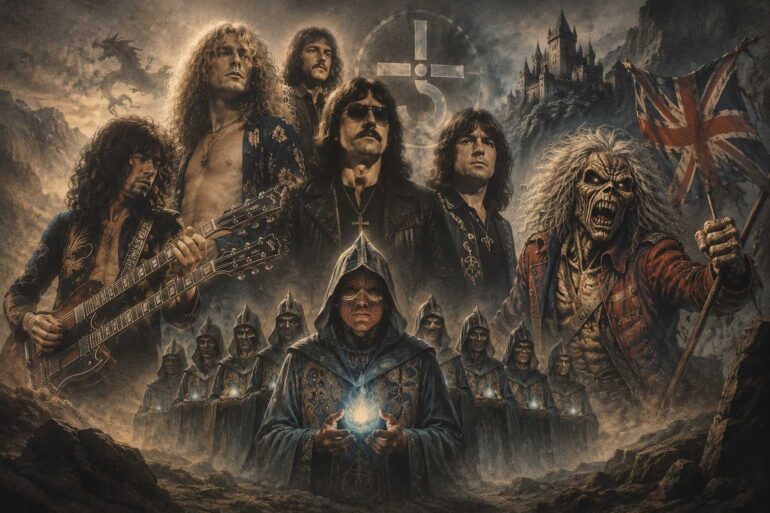
Fantasy and heavy music share many core themes, including war, prophecy, supernatural power, ruined kingdoms, heroic quests, and cosmic conflict.
Rock and metal bands have used fantasy literature in several ways.
Some adapt full stories, while others borrow characters, locations, terminology, or mythology.
Band names, album concepts, artwork, lyrics, and musical atmosphere can all show literary influence.
1. Blind Guardian and J.R.R. Tolkien’s Middle-earth
Blind Guardian has built much of its identity around fantasy literature, especially Tolkien’s mythology.
Nightfall in Middle-Earth adapts major events in The Silmarillion.
Songs such as “Nightfall” and “Mirror Mirror” focus on grief, exile, pride, war, and betrayal. Short narrated passages connect the tracks and help organize the story.
Layered vocals, large choruses, and dramatic arrangements give the album the scale of an epic narrative.
Blind Guardian treats Tolkien’s work as source material for a full concept album rather than using isolated references.
“The Bard’s Song: In the Forest” is not tied to one Tolkien episode, but its wandering storyteller and communal tone fit the band’s broader fantasy identity.
Interest in Tolkien-inspired music can also lead listeners toward other fantasy stories available through a fiction reading site.
2. Led Zeppelin and Tolkien References in Early Hard Rock

Led Zeppelin brought Tolkien references into mainstream hard rock during the genre’s early years.
- “Ramble On” names Mordor and Gollum while describing loss and travel.
- “Misty Mountain Hop” borrows the name of Tolkien’s mountain range for a modern story.
- “The Battle of Evermore” uses dark riders, approaching armies, and heroic resistance.
“The Battle of Evermore” comes closest to epic fantasy. Its acoustic arrangement and contrasting vocals create the feel of an old battle song.
Led Zeppelin did not adapt Tolkien through full concept albums. Instead, the band placed Middle-earth references inside blues, folk, and hard rock songs.
Such a loose approach helped make fantasy literature a credible subject in popular rock.
3. Summoning and Middle-earth Through Atmospheric Black Metal
Summoning draws heavily on The Lord of the Rings, The Silmarillion, and other parts of Tolkien’s mythology.
Album titles such as Minas Morgul, Dol Guldur, and Stronghold refer to fortresses, dark territories, and war. “Land of the Dead” continues the band’s focus on ancient places and lost history.
Summoning rarely retells one story in a direct sequence. Its main achievement is atmosphere. Sound, pacing, and repetition make listeners feel as though they are inside Tolkien’s world.
4. Cirith Ungol and Sword-and-Sorcery Darkness

Cirith Ungol took its name from the mountain pass near Mordor where Frodo and Sam encounter Shelob.
Michael Moorcock’s Elric stories also shaped the band’s identity. Albums such as Frost and Fire and King of the Dead use sword-and-sorcery imagery connected to doomed heroes, magical weapons, and apocalyptic conflict.
- Michael Whelan paintings connected to Moorcock’s fiction appeared on album covers.
- Pale warriors and enchanted weapons replaced conventional rock photography.
- Apocalyptic skies and monstrous enemies matched the music’s fatalistic tone.
Cirith Ungol combines classic heavy metal with darker elements that later became common in doom and extreme metal. Tolkien supplied the name, while Moorcock supplied much of the band’s fatalistic imagery.
5. Blue Öyster Cult and Michael Moorcock’s Black Sword

Blue Öyster Cult’s “Black Blade” is based on Michael Moorcock’s Elric stories.
Elric is a physically weak emperor who depends on magical forces for strength. His sword, Stormbringer, consumes souls and often harms the people closest to him.
- It possesses its own hunger and will.
- It gives Elric strength while increasing his dependence.
- It kills enemies and allies without respecting human loyalty.
- It turns every victory into another stage of Elric’s decline.
“Black Blade” presents the weapon as a controlling and almost sentient force. Elric carries it, but the sword appears to direct his actions.
Moorcock contributed lyrics to the song, making it a direct collaboration between a fantasy author and a rock band.
Included on Cultösaurus Erectus, “Black Blade” condenses Elric’s dependence, violence, and moral conflict into a single hard rock track.
6. Hawkwind and Moorcock’s Multiverse
Hawkwind, one of the classic rock bands at the time, had a long creative relationship with Michael Moorcock. He performed with the band, contributed spoken passages, and worked on projects connected to his fiction.
Moorcock’s Eternal Champion stories follow recurring heroic figures across different worlds and identities. Magic, advanced technology, collapsing civilizations, and cosmic conflict often exist in the same setting.
- Synthesizers create unstable and unfamiliar environments.
- Repetitive rhythms suggest continuous travel across space and time.
- Spoken narration introduces characters and philosophical ideas.
- Extended compositions allow scenes to shift without standard song structures.
Warrior on the Edge of Time draws heavily on Eternal Champion concepts. “The Black Corridor” also connects the band to Moorcock’s fiction.
Blue Öyster Cult focused on Elric and Stormbringer in one major song. Hawkwind used Moorcock’s wider mythology across performances, recordings, and spoken-word collaborations.
7. Eternal Champion and the Recurring Hero

Eternal Champion takes its name from Moorcock’s cycle of recurring warriors.
Across the novels, different champions appear in separate worlds and identities while taking part in a larger struggle involving cosmic balance.
Albums such as The Armor of Ire and Ravening Iron use traditional heavy-metal riffs, martial rhythms, heroic vocals, and sword-and-sorcery imagery.
Rather than adapting one novel, the band adopts Moorcock’s mythology as a full identity. Its name, lyrics, artwork, and musical style all center on warriors, fate, battle, and duty.
Eternal Champion also shows that Moorcock’s influence continues in modern metal.
8. Caladan Brood and Malazan Book of the Fallen
Caladan Brood takes its name from a major character in Steven Erikson’s Malazan Book of the Fallen.
Erikson’s series includes military campaigns, gods, ancient species, empires, fallen civilizations, and complex magical systems.
- “City of Azure Fire” refers to Darujhistan, one of the series’ major cities.
- “Book of the Fallen” adopts the title and tragic focus of Erikson’s series.
- Long compositions match a story told across continents and historical periods.
- Choral passages add the feeling of mourning, ritual, and collective memory.
Extended compositions allow melodies and themes to develop slowly. Harsh vocals express violence and loss, while clean choral sections add grief and ceremony.
Caladan Brood focuses not only on war, but also on exhaustion, loyalty, sacrifice, and moral uncertainty. Its music shows how modern epic fantasy can support detailed metal interpretation outside Tolkien and Moorcock.
9. Demons & Wizards and Stephen King’s The Dark Tower
Parts of Demons & Wizards’ Touched by the Crimson King draw on Stephen King’s The Dark Tower series.
King’s saga combines fantasy, horror, western fiction, science fiction, and post-apocalyptic settings. Roland Deschain, the last gunslinger, pursues the Dark Tower through unstable worlds filled with monsters and ruined communities.
“The Gunslinger” uses restrained passages and heavier sections to match Roland’s grief, discipline, and obsession.
Not every song adapts The Dark Tower. Some tracks use broader horror and fantasy themes. Still, the album’s darker power-metal sound fits the series’ sacrifice, madness, cosmic conflict, and damaged worlds.
10. Iron Maiden and Orson Scott Card’s Seventh Son

Iron Maiden’s Seventh Son of a Seventh Son was inspired partly by Orson Scott Card’s Seventh Son and by folklore surrounding the seventh son of a seventh son.
Traditional belief gives such a child supernatural powers. Iron Maiden, the very best classic rock band of the time, used that idea to build a concept around prophecy, clairvoyance, destiny, and conflict between opposing forces.
Title track “Seventh Son of a Seventh Son” presents a gifted child whose powers may affect future events.
“The Clairvoyant” focuses on someone able to see hidden truths and possible futures. That ability becomes a source of danger rather than comfort.
Album concept does not reproduce Card’s novel scene by scene. It combines literary influence, folklore, and Iron Maiden’s own story.
Synthesizers, galloping rhythms, and extended instrumental sections support the album’s supernatural tone.
Summary
Fantasy literature can shape music through concept albums, individual songs, band names, artwork, author collaborations, and atmosphere.
Strong fantasy-inspired music does more than mention characters or places. It converts war, tragedy, prophecy, corruption, sacrifice, and heroism into riffs, rhythms, vocals, and album structures.
Fantasy and metal continue to work well together because both deal comfortably with conflict on a mythic scale.
- AI Can Mimic Creativity but It Will Never Replace the Human Artist - September 8, 2026
- 10 Classic Rock Albums Everyone Hated Before They Became Cult Classics - September 3, 2026
- 7 Best DAWs for Beginners and Professional Audio Engineers in 2026 - September 3, 2026