



In 2026, music royalties are the result of a complex ecosystem of revenue sources, streaming services, traditional broadcasts like radio and TV, synchronization (sync) licensing, and publishing splits between songwriters and publishers. Each of these channels pays out in different ways, with streaming now the dominant revenue contributor globally, but radio and sync generating substantial income through performance broadcasts and commercial licensing.
The economics of royalties are governed by a mix of statutory rates, negotiated contracts, collective collection systems, and platform payout models such that a single song can generate multiple, simultaneous royalty streams depending on how it is used, where it is consumed, and who owns which rights.
Streaming Royalties: How Plays Turn Into Payments
Streaming represents the largest revenue source in recorded music. According to data from the IFPI and industry reports through 2025, streaming generated roughly 69% of global recorded music revenue in 2024 and remains the dominant revenue type into 2026. Paid subscriptions and ad revenue form the pool that is shared with rights owners through a revenue-share model, not a fixed per-stream price.
Streaming Payout Rates (Approximate 2025 Base, Used as a 2026 Proxy)
| Platform | Estimated Payout per Stream (USD) | Notes |
| Apple Music | ~$0.007–$0.01 | Premium only, higher per-stream value. |
| TIDAL / Qobuz | ~$0.012–$0.022 | High-resolution/premium user-centric models. |
| Spotify | ~$0.003–$0.005 | Massive reach but lower per-stream because of ad-supported tier. |
| Amazon Music | ~$0.004–$0.008 | Moderate payouts, large user base. |
| Deezer | ~$0.0011–$0.0064 | Variable by region and subscription level. |
| YouTube Music | ~$0.0009–$0.002 | Low per-stream but high play volume. |
Streaming platforms do not pay a fixed amount per stream. Instead, they collect revenue from subscriptions and advertising, deduct their share (often around 30%), and distribute roughly 65–70% of net revenue to rights holders. On Spotify, for example, rights holders receive about 70% of platform revenue, with the remainder retained by the platform.
The actual amount an artist receives per stream is influenced by:
- Subscription tier (free vs premium)
- Listener geography (U.S., UKpaysy more than lower-income markets)
- Contract terms and distributor cut (often 15–30%)
- Revenue share vs user-centric payout method
Because of these factors, an average Spotify payout of ~$0.0035 can mean ~28,500 streams to earn $100.
Radio & Performance Royalties (Public Performance)

When music is broadcast on terrestrial or digital radio, TV, or public venues (bars, stores, live events), performance royalties are triggered. These royalties are collected by Performing Rights Organizations (PROs) such as ASCAP, BMI, SESAC in the United States, or PRS for Music / MCPS in the UK.
In the U.S., PROs typically split performance royalties 50% to songwriters and 50% to publishers if a publisher is registered. If the songwriter self-publishes, they collect both shares. Radio royalties are not paid for sound recordings in the U.S. (only for compositions), whereas in many other countries, rights societies pay both composition and neighboring rights (performance of recording) for broadcasts.
In 2025, the UK’s PRS distributed nearly £275 million ($350M+) in royalties, sourced from a mix of streaming, radio broadcasts, and other uses.
Performance royalties are predictable and recurring because they automatically accrue whenever a song is publicly played and matched through broadcast logs or digital-fingerprinting systems.
Sync Licensing: One-Time Payments for One-Time Uses
Synchronization licenses occur when a song is used in film, TV, commercials, video games, corporate videos, mobile apps, or advertising campaigns. These are typically one-time, negotiated payments, not recurring per-play royalties.
Typical sync license fees (2025 data, still relevant in 2026):
| Usage Type | Typical Sync License Fee (USD) | Context |
| Local ad | $1,000 – $5,000 | Small market campaigns. |
| National TV | $10,000 – $50,000 | Mid-tier campaigns. |
| Global brand campaign | $100,000 – $250,000+ | Major advertising sync. |
| Indie video game | $1,000 – $5,000 | Video game sync. |
Sync deals vary by territory, song popularity, exclusivity, and duration. A blockbuster TV spot or franchise trailer can command several hundred thousand dollars for a popular track, while a micro-sync on social media might be worth only a few dollars.
Sync income is valuable because it is often upfront and non-recoupable, meaning artists and rights holders receive cash immediately upon licensing.
Publishing Splits: Who Gets Paid, How Much, and When

Publishing royalties are a separate category from the master recording payouts. These go to songwriters and music publishers and include both:
- Mechanical royalties (for reproducing the composition, including streaming)
- Performance royalties (for public use of the composition)
- Sync fees (composition use in visual media)
Publishing Revenue Breakdown (Approximate as of 2025)
According to industry data, modern publishing revenue tends to be:
| Mechanical (incl. streaming) | ~35% |
| Performance | ~42% |
| Sync Licensing | ~15% |
| Other (VR, gaming, micro licenses) | ~8% |
In the U.S., statutory mechanical royalty rates on interactive streams are set by a government board (CRB) and are being phased upward. Under the Phonorecords IV ruling, songwriters and publishers are set to receive about 15.3% of a streaming service’s revenue in 2026, an increase toward the 2027 target of 15.35%.
Publishing splits are typically:
- 50% to songwriter(s)
- 50% to publisher
If a songwriter self-publishes, they retain both halves. Many independent songwriters use publishing administrators (like Songtrust or CD Baby) to collect global royalties.
How All of This Adds Up in 2026
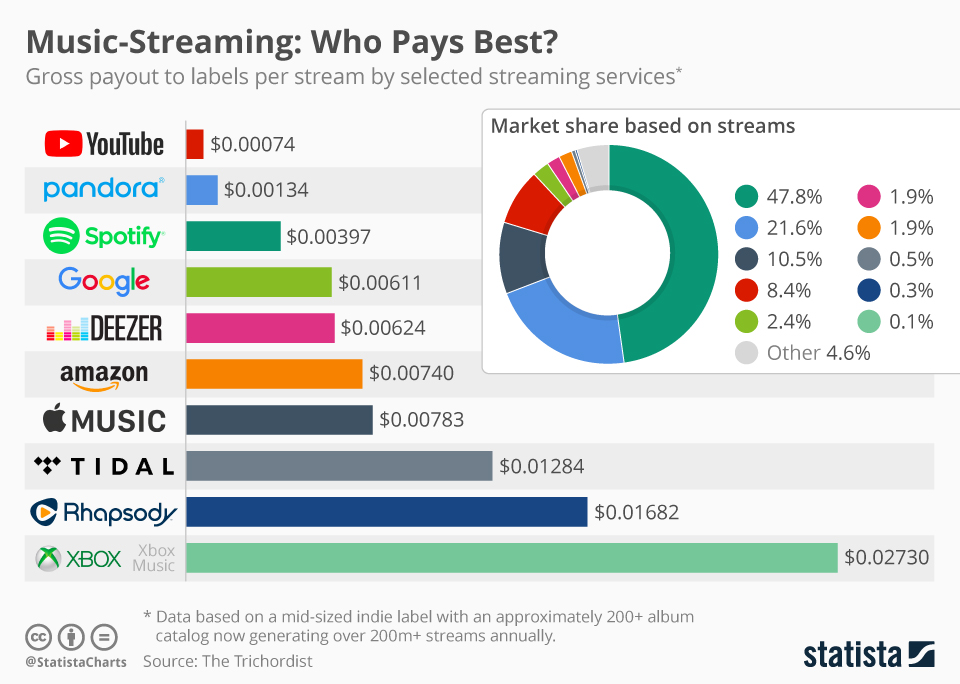 You will find more infographics at Statista
In 2026, an individual song can generate royalties simultaneously from:
- Streaming services (both master and publishing royalties)
- Radio and broadcast performance (performance royalties)
- Sync deals (one-time licensing fees)
- Digital downloads (less common but still paid)
- Neighboring rights (in some countries)
Because different collections happen through different systems (e.g., streaming direct via platforms, performance via PROs, mechanical via statutory or collective licensing), rights holders must properly register titles, writer shares, and metadata to collect all income.
The global music publishing market, which captures these income flows, was valued at around $7.7 billion in 2025 and continues to grow toward 2030, driven by both digital streaming and sync licensing.
Conclusion
By 2026, streaming will remain the backbone of recorded music revenue, but it rewards scale more than density (i.e., many plays generate income, not a high per-stream rate). Traditional radio and broadcasting still provide reliable performance royalties, while sync licensing offers high-value opportunities on a case-by-case basis.
Publishing splits, governed by statutory rates and collection societies, determine how composition income is shared between writer and publisher.
Pay rates are empirical, variable by platform and territory, and dependent on proper metadata and rights registration. Effective royalty collection in 2026 requires a clear understanding of the distinctions between masters and compositions, performance vs mechanical income, and the role of collective administration, without which creators leave money unclaimed.

- How Can Independent Musicians Sell More Music In 2026? - February 12, 2026
- Bandcamp Vs Spotify For Indie Musicians – Revenue, Fan Data, Long-Term Strategy - February 2, 2026
- Best Free VST Plugins for Rock Producers – EQ, Compression, Amp Sims, Reverbs - January 31, 2026